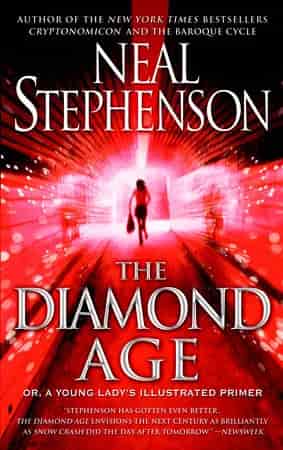
Neal Stephenson
Quotes
"And what makes one man's life more interesting than another’s?"
"In general, I should say that we find unpredictable or novel things more interesting."
…"You yourself said that the engineers in the Bespoke department—the very best—had led interesting lives, rather than coming from the straight and narrow. Which implies a correlation, does it not?”
"Clearly."
"This implies, does it not, that in order to raise a generation of children who can reach their full potential, we must find a way to make their lives interesting.”
The bells of St. Mark's were ringing changes up on the mountain when Bud skated over to the mod parlor to upgrade his skull gun.
But as many first-time fathers had realized in the delivery room, there was something about the sight of an actual baby that focused the mind. In a world of abstractions, nothing was more concrete than a baby.
"Nell stands above the fray and thinks," Finkle-McGraw said. "To the other girls, the wall is a decorative feature, no? A pretty thing to run to and explore. But not to Nell. Nell knows what a wall is. It is a knowledge that went into her early, knowledge she doesn't have to think about. Nell is more interested in gates than in walls. Secret hidden gates are particularly interesting."
We ignore the blackness of outer space and pay attention to the stars, especially if they seem to order themselves into constellations.
“Have you done anything the Shanghai Police might find interesting?” Brad asked Harv gravely. Harv said no, a simple no without the usual technicalities, provisos, and subclauses.
Ordering matter was the sole endeavor of Life, whether it was a jumble of self-replicating molecules in the primordial ocean, or a steam-powered English mill turning weeds into clothing, or Fiona lying in her bed turning air into Fiona.
"Your case is very serious," he said to the boy. "We will go and consult the ancient authorities…."
The House of the Venerable and Inscrutable Colonel was what they called it when they were speaking Chinese. Venerable because of his goatee, white as the dogwood blossom, a badge of unimpeachable credibility in Confucian eyes. Inscrutable because he had gone to his grave without divulging the Secret of the Eleven Herbs and Spices. It had been the first fast-food franchise established on the Bund, many decades earlier.
“We take a somewhat different view of hypocrisy,“ Finkle-McGraw continued. “In the late-twentieth-century Weltanschauung, a hypocrite was someone who espoused high moral views as part of a planned campaign of deception---he never held these beliefs sincerely and routinely violated them in privacy. Of course, most hypocrites are not like that. Most of the time it's a spirit-is-willing, flesh-is-weak sort of thing.“
Along with many other Midwesterners, Finkle-McGraw put in a few weeks building levees out of sandbags and plastic sheeting. Once again he was struck by the national media coverage—reporters from the coasts kept showing up and announcing, with some bewilderment, that there had been no looting. ... Finkle-McGraw began to develop an opinion that was to shape his political views in later years, namely, that while people were not genetically different, they were culturally as different as they could possibly be, and that some cultures were simply better than others. This was not a subjective value judgment, merely an observation that some cultures thrived and expanded while others failed. It was a view implicitly shared by nearly everyone but, in those days, never voiced.
They only have one book in Sendero, and it tells them to burn all the other books.
Bud's relationship with the female sex was governed by a gallimaufry of primal impulses, dim suppositions, deranged theories, overheard scraps of conversation, half-remembered pieces of bad advice, and fragments of no-doubt exaggerated anecdotes that amounted to rank superstition.