Naomi Klein
Quotes
The American Society of Civil Engineers said in 2007 that the U.S. had fallen so far behind in maintaining its public infrastructure -- roads, bridges, schools, dams -- that it would take more than a trillion and half dollars over five years to bring it back up to standard. Instead, these types of expenditures are being cut back. At the same time, public infrastructure around the world is facing unprecedented stress, with hurricanes, cyclones, floods and forest fires all increasing in frequency and intensity. It's easy to imagine a future in which growing numbers of cities have their frail and long-neglected infrastructures knocked out by disasters and then are left to rot, their core services never repaired or rehabilitated. The well-off, meanwhile, will withdraw into gated communities, their needs met by privatized providers. (p415)
 The Shock Doctrine
As for journalists and activists, we seemed to be exhausting our attention on the spectacular physical attacks, forgetting that the parties with the most to gain never show up on the battlefield. (p326)
The Shock DoctrineIt's not that one sphere is more important than the other. It's that we have to do both: the local and the global. The resistance and the alternatives. The "nos" to what we cannot survive and the "yeses" that we need to thrive.
 On Fire
The widespread abuse of prisoners is a virtually foolproof indication that politicians are trying to impose a system--whether political, religious or economic--that is rejected by large numbers of the people they are ruling. Just as ecologists define ecosystems by the presence of certain "indicator species" of plants and birds, torture is an indicator species of a regime that is engaged in a deeply anti-democratic project, even if that regime happens to have come to power through elections. (p125)
The Shock DoctrineThe title No Logo is not meant to be read as a literal slogan (as in No More Logos!), or a post-logo logo (there is already a No Logo clothing line, or so I'm told). Rather, it is an attempt to capture an Anticorporate attitude I see emerging among many young activists. This book is hinged on a simple hypothesis: that as more people discover the brand-name secrets of the global logo web, their outrage will fuel the next big political movement, a vast wave of opposition squarely targeting transnational corporations, particularly those with very high name-brand recognition.
 No Logo
What haunts me is not exactly the absence of literal space so much as a deep craving for metaphorical space: release, escape, some kind of open-ended freedom.
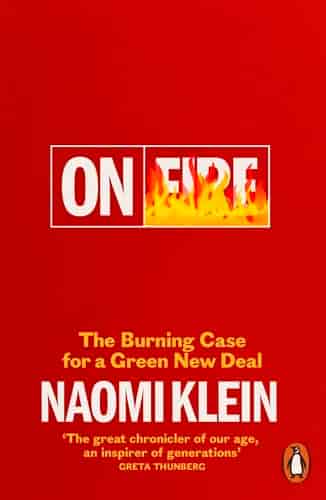
No LogoBecause our house is on fire, and this should come as no surprise. Built on false promises, discounted futures, and sacrificial people, it was rigged to blow from the start. It's too late to save all our stuff, but we can still save each other and a great many other species, too. Let's put out the flames and build something different in its place. Something a little less ornate, but with room for all those who need shelter and care. Let's forge a Global Green New Deal-for everyone this time. (from the Introduction)
On FireThe recent spate of disasters has translated into such spectacular profits that many people around the world have come to the same conclusion: the rich and powerful must be deliberately causing the catastrophes so that they can exploit them. (p426)
The Shock DoctrineAs we look back, it seems like willful blindness. The abandonment of the radical economic foundation of the women's and civil-rights movements by the conflation of causes that came to be called political correctness successfully retrained generation of activists in the politics of image, not action.
No LogoRather than calling attention to the house of mirrors, that passes for empirical truth (as postmodern acadimics did), and rather than fighting for better mirrors (as the ID warriors did), today's media activists are concentrating on shattering the impenetrable shiny surfaces of branded culture, picking up the pieces and using them as sharp weapons in a war of actions, not ideas.
No LogoAs a means of extracting information during interrogations, torture is notoriously unreliable, but as a means of terrorizing and controlling populations, nothing is quite as effective. (p126)
The Shock DoctrineThe theory of economic shock therapy relies in part on the role of expectations on feeding an inflationary process. Reining in inflation requires not only changing monetary policy but also changing the behavior of consumers, employers and workers. The role of a sudden, jarring policy shift is that it quickly alters expectations, signaling to the public that the rules of the game have changed dramatically— prices will not keep rising, nor will wages. (p82)
The Shock Doctrine