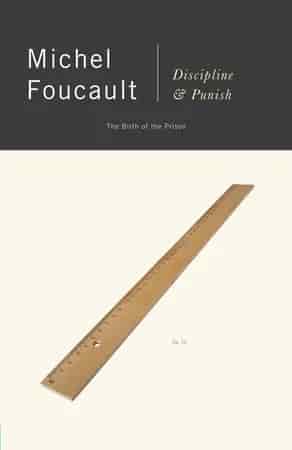
Michel Foucault
Quotes
It is ugly to be punishable, but there is no glory in punishing. Hence the double system of protection that justice has set up between itself and the punishment it imposes.
p. 10
Exercise is the technique by which one imposes on the body tasks that are both repetitive and different, but always graduated. By bending behavior towards a terminal state, exercise makes possible a perpetual characterization of the individual...It thus assures, in the form of continuity and constraint, a growth, an observation, a qualification.
The chief function of the disciplinary power is to 'train', rather than to select and to levy; or, no doubt, to train in order to levy and select all the more. It does not link forces together in order to reduce them; it seeks to bind them together in such a way as to multiply and use them
This, then, is how one must imagine the punitive city. At the crossroads, in the gardens, at the side of roads being repaired or bridges built, in workshops open to all, in the depths of mines that may be visited, will be hundreds of tiny theatres of punishment. Each crime will have its law; each criminal his punishment. It will be a visible punishment, a punishment that tells all, that explains, justifies itself, convicts: placards, different-coloured caps bearing inscriptions, posters, symbols, texts read or printed, tirelessly repeat the code. Scenery, perspectives, optical effects, trompe-l'œil sometimes magnify the scene, making it more fearful than it is, but also clearer. From where the public is sitting, it is possible to believe in the existence of certain cruelties which, in fact, do not take place. But the essential point, in all these real or magnified severities, is that they should all, according to a strict economy, teach a lesson: that each punishment should be a fable. And that, in counterpoint with all the direct examples of virtue, one may at each moment encounter, as a living spectacle, the misfortunes of vice. Around each of these moral ‘representations’, schoolchildren will gather with their masters and adults will learn what lessons to teach their offspring. The great terrifying ritual of the public execution gives way, day after day, street after street, to this serious theatre, with its multifarious and persuasive scenes. And popular memory will reproduce in rumour the austere discourse of the law. But perhaps it will be necessary, above these innumerable spectacles and narratives, to place the major sign of punishment for the most terrible of crimes: the keystone of the penal edifice.
The criticism of the reformers was directed not so much at the weakness or cruelty of those in authority, as at a bad economy of power.
Beneath the humanization of the penalties, what one finds are all those rules that authorize, or rather demand, 'leniency', as a calculated economy of the powder to punish. But they also provoke a shift in the point of application of this power: it is no longer the body, with the ritual play of excessive pains, spectacular branding in the ritual of the public execution; it is the mind or rather a play of representations and sings circulating discreetly but necessarily and evidently in the minds of all. It is no longer the body, but the soul, said Mably. And we see very clearly what he meant by this term: the correlative of a technique of power. Old 'anatomies' of punishment are abandoned, But have we really entered the age of non-corporal punishment?
p. 101
In the ceremonies of the public execution, the main character was the people, whose real and immediate presence was required for the performance.
p. 56
The condemned man found himself transformed into a hero by the sheer extend of his widely advertised crimes, and sometimes the affirmation of his belated repentance. Against the law, against the rich, the powerful, the magistrates, the constabulary or the watch, against taxes and their collectors, he appeared to have waged a struggle with which one all too easily identified. The proclamation of these crimes blew up to epic proportions the tiny struggle that passed unperceived in everyday life. If the condemned man was shown to be repentant, accepting the verdict, asking both God and man for forgiveness for his crimes, it was as if he had come through some process of purification: he died, in his own way, like a saint.
p. 67
Not only must people know, they must see with their own eyes. Because they must be made to be afraid; but also because they must be the witnesses, the guarantors, of the punishment, and because they must to a certain extent take part in it.
p. 58
This book is intended as a correlative history of the modern soul and of a new power to judge; a genealogy of the present scientifico-legal complex from which the power to punish derives its bases, justifications and rules, from which it extends its effects and by which it extends its effects and by which it masks its exorbitant singularity.
p. 42
There is no power relation without the correlative constitution of a field of knowledge, nor any knowledge that does not presuppose and constitute at the same time power relations
The man described for us, whom we are invited to free, is already in himself the effect of a subjection much more profound than himself. A 'soul' inhabits him and brings him to existence...the soul is the effect and instrument of political anatomy; the soul is the prison of the body.