
Michael Burleigh
Quotes
Just as the SS was the most implacable in its persecution of racially unwanted, so it single-mindedly pursued the goal of integrating all Germans on the basis of racial equality. Himmler sincerely meant it when he warned his German SS men to behave respectfully towards their foreign racial comrades.
p. 430
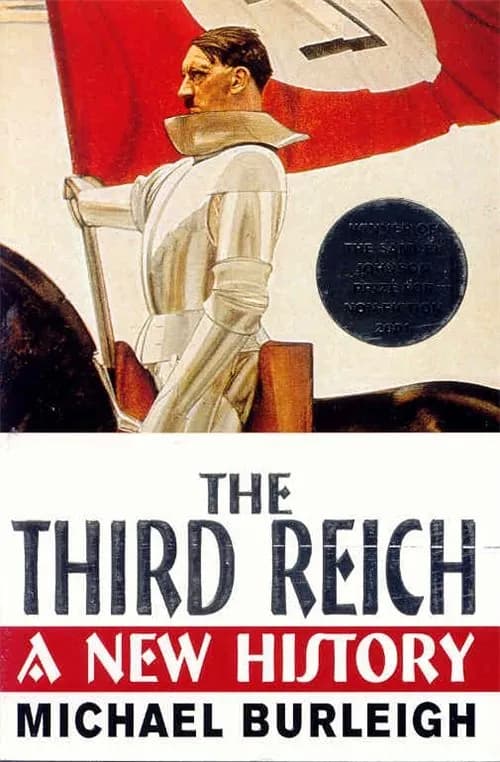 The Third Reich
The Enabling Law permitted the government to pass budgets and promulgate laws, including those altering the constitution, for four years without parliamentary approval. In democracies, constitutional amendments are especially solemn moments; here they were easier than changing the traffic regulations. None of the guarantees Hitler extended to the Churches or the judiciary in his address to the Reichstag amounted to a hill of beans.
p. 154
The Third ReichChristianity regarded all earthly existence as transient, while the Nazi thought in terms of rendering life eternal through a sort of biological Great Chain of Being. The individual was nothing, but the racial collective would endure through the aeons.
p. 256
The Third ReichThe major faultline running through the left wing of the working class, for by no means all workers came under the rubric, was hostility between the Communists and Social Democrats. Between 1928 and 1934 the Communist Party (KPD) adhered to an inflationary use of the term ‘fascism’ to describe not only the Nazis, but also the previous chancellors and the ‘social fascists’ of the ( SPD)
p. 665
The Third ReichWhatever Christianity’s ambivalences and antagonisms towards the Jews, its core concerns with compassion and humility were anathema to a politics of racial egotism, and worship of brutality and strength. These ‘aspects’ of Christianity would have to be expunged. In Nazi eyes, Christianity was ‘foreign’ and ‘unnatural’, or what has been described as the Jews’ ‘posthumous poison’, a notion that Nazis picked up from Nietzsche.
p. 256
The Third ReichFor, despite its egalitarian rhetoric, Nazi Germany eschewed the doctrine of aggressive class war, whatever revolutionist animosities lingered, against the limp bourgeoisie in general.
p. 161
The Third ReichMarxist socialism also had dark nooks and crannies where Jews were regarded as money-mad capitalists or as an ‘obsolete’ people who refused to join the onward march of secular progress towards a moneyless society. Anarchists also suffered from this contagion,…
p. 94
The Third ReichThe advent of Bolshevik, Fascist and National Socialist regimes in Russia and Europe successively between 1917 and 1933 led some contemporary intellectuals to wonder whether their own terminology adequately conveyed the scope of these regimes’ pretentions or the horrors they were responsible for. Of course, many intellectuals did not view them as horrors at all, but rather collateral costs of supposedly bright future.
p. 4
The Third ReichPower was briefly seized by the Communists, who proclaimed a Bavarian Soviet Republic. Their leader, Eugen Levine, received the blessing of Lenin, who characteristically wished to know how many bourgeois hostages had been taken. A ‘classist’ tone was soon apparent. Milk shortages were rationalized with the argument: ‘What does it matter? . . . Most of it goes to the children of the bourgeoisie anyway. We are not interested in keeping them alive. No harm if they die – they’d only grow into enemies of the proletariat.’
p. 40
The Third ReichNazi ideology offered redemption from a national ontological crisis, to which it was attracted like a predatory shark to blood.
p. 12
The Third ReichRoman Catholic priests in Germany were enjoined to shun National Socialism, and the Nazis did not get from them the clerical endorsement they often enjoyed in Protestant areas. Only a handful of priests supported Nazism, mostly malcontents or naifs, like Abbot Schachleiter, who argued that ‘if the Catholics do not co-operated with the NSDAP, there is a danger that National Socialism will become a purely Protestant movement.’
p. 70
The Third Reich


That’s all the quotes.
11 quotes in the collection · come back when we add more