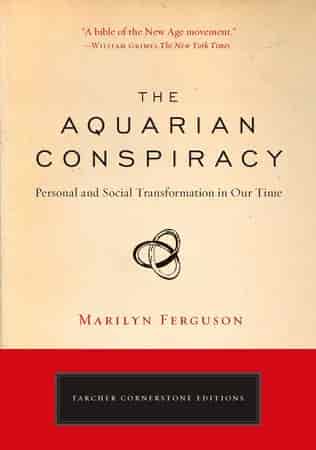
Marilyn Ferguson
Quotes
Long before Thomas Kuhn observed that new ideas may have to wait for a new generation's acceptance, folk wisdom made this bittersweet point. A Hebrew proverb warns, Do not confine your children to your own learning, for they were born in another time. Karl Pribram once commented that a new generation will learn about paradox in the early grades and will grow up understanding concepts of primary and secondary levels of reality. p. 321
We begin to see the unease and disease of our adult lives as elaborate patterns that emerged from a system that taught us young how to be still, look backward, look to authority, construct certainties. The fear of learning—and transformation—is the inevitable product of such a system.
There are heroes in education, as there have always been heroes, trying to transcend the limits of the old structure; but their efforts are too often thwarted by peers, administrators, parents. Mario Fantini, former Ford consultant on education, now at the State University of New York, said bluntly, The psychology of becoming has to be smuggled into the schools.
A political paradigm shift might be said to occur when the new values are assimilated by the dominant society. These values then become social dogma to members of a new generation, who marvel that anyone could ever have believed otherwise.
If our memories are as absorbent as research has demonstrated, our awareness as wide, our brains and bodies as sensitive; if we can will changes in our physiology at the level of a single cell; if we are heirs to such evolutionary virtuosity—how can we be performing and learning at such mediocre levels? If we're so rich, why aren't we smart? p. 279
Just as scientists inevitably come across facts that contradict the existing paradigm, so individuals within a society begin to experience anomalies and conflicts: an unequal distribution of power, an abridgement of freedoms, unjust laws or practices... If this conflict is too intense or focused to be suppressed, a revolution eventually occurs in the form of a social movement. The old consensus is broken, and freedoms are extended.
For too long, like the Kentucky slaveholders, we have turned our best energies toward the pursuit of secondary excitement, hoping to find in such distractions the reward that comes only from vocation. But we have a choice; now we can emigrate to a freer state, finding there new heart, new enterprise, and values that match our deepest needs.
Buying, selling, owning, saving, sharing, keeping, investing, giving—these are outward expressions of inward needs. When those needs change, as in personal transformation, economic patterns change.
If the streambed of education is being enlarged, one formidable force altering its contours is competition. Learning is where you find it: on "Sesame Street," in inner games of tennis and the Zen of everything, in teaching and learning cooperatives, in computers, on FM radio, in self-help books, in magazines... and television documentaries.
Inner listening makes clearer to us what we really want, as distinct from what we have been talked into, and it might not have a price tag. We may also discover that "ownership" is in some sense an illusion, that holding on to things can keep us from freely enjoying them. Greater awareness may give us new appreciation for simple things.
Schools are entrenched bureaucracies whose practitioners do not compete for business, do not need to get re-elected or to attract patients, customers, clients. Those educators who would like to innovate have relatively little authority to change their style.
Our best hope now is to pay attention, to recognize the ways in which our lives and livelihood have been influenced, even run, by outmoded structures. Our ideas about work, money, and management grew out of an old stable social order irrelevant to present flux and were based on a view of humankind and nature long since transcended in science. The real world turns on different principles than those imposed by our partial economic philosophies.