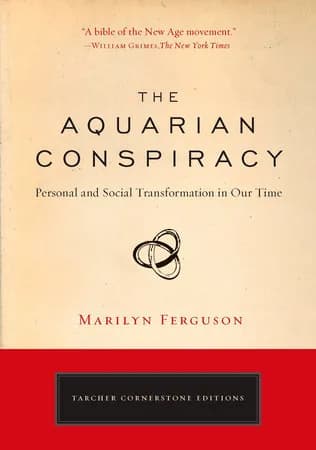
Marilyn Ferguson
Quotes
A junior-high student, John Shimotsu of Los Angeles, tried his hand at interpreting for his fellow eighth graders the holographic model of reality proposed by Pribram and physicist David Bohm. In conclusion, he said:
Why can't you perform actions that we consider paranormal? I think it is because you do not think you can. You may say you wish to, or may sincerely want to, but that will not change what you subconsciously think. Our culture says that those actions would not be possible, so that is what you think is real. To change your reality, you would have to alter your innermost thoughts. The holographic idea is fascinating. What is theory today may be fact tomorrow.
Health care (including medical insurance) is now the third largest industry in the United States; medical costs are roughly 9 percent of the Gross National Product. Federal health costs are over fifty billion dollars. Neighboring hospitals duplicate expensive equipment, doctors order unnecessary laboratory tests to protect themselves from malpractice suits ("defensive medicine"). Even a simple office call now represents a major expenditure to the average person. Runaway costs, especially hospital charges, have made it all but impossible to enact any sort of national health plan. p. 244
Another strong force for change: crisis. All the failures of education, like a fever, signal a deep struggle for health.
Gandhi carried the concept of the powerful committed minority into the twentieth century, first gaining recognition of the rights of Indians living in South Africa and then achieving India's independence from British domination. "It is a superstitious and ungodly thing to believe that an act of a majority binds a minority," he said. "It is not numbers that count but quality.... I do not regard the force of numbers as necessary in a just cause."
It's like the old dilemma: You can't get a job without experience, but you can't get experience because no one will give you a job.
Everything of importance is already known, a sage said—the only thing is to rediscover it. Much of the current excitement about healing is a kind of collective remembering, a homecoming to the old wives and old doctors.
The revolutionary principle introduced by Gandhi resolves the paradox of freedom. He called it satyagraha, "soul force" or "truth force." Satyagraha was essentially misunderstood in the West, described as "passive resistance," a term Gandhi disavowed because it suggests weakness, or "non-violence," which was just one of its components.
The autonomy so evident in social movements is hitting the old assumptions of medicine hard. The search for self becomes a search for health, for wholeness—the cache of sanity search for health, for wholeness—the cache of sanity and wisdom that once seemed beyond our conscious reach. p. 241
All over the world, children and young people are being exposed, via the communications revolution, to such ideas. They are not limited to the parochial beliefs of a single culture. p. 321
The hope for real social transformation need not rest on circumstantial evidence. One major arena, health care, has already begun to experience wrenching change. The impending transformation of medicine is a window to the transformation of all our institutions. Here we can see what happens when consumers begin to withdraw legitimacy from an authoritarian institution. We see the rise of the autonomous health seeker, the transformation of a profession by its leadership, the impact of the new models from science, the way decentralized networks are effecting wide geographic change.
If education cannot be mended, perhaps it can metamorphose. As someone pointed out, trying to explain the difference between reform and transformation, we have been trying to attach wings to a caterpillar. Our interventions in the learning process to date have been almost that crude. It is high time we freed ourselves of attachment to old forms and eased the flight of the unfettered human mind. p. 321
This chapter is about learning in its broadest sense. It's about our surprising capacities, new sources of knowledge, mastery, creativity. It's about the learner within, waiting to be free. And it's about how the learner came to be unfree... about our culture's great learning disability, an educational system that emphasizes being "right" at the expense of being open. p. 280