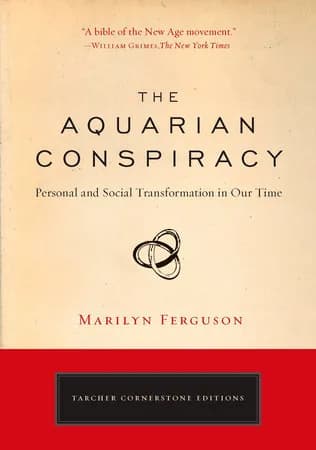
Marilyn Ferguson
Quotes
Human beings have a kind of optical illusion, Einstein once said. We think ourselves separate rather than part of the whole. This imprisons our affection to those few nearest us.
Critics call them narcissistic, not knowing the thoughtful nature of their inward search; self-annihilating, not knowing the spaciousness of the Self they join; elitist, not knowing how desperately they want to share what they have seen; irrational, not realizing how much further their new worldview goes toward resolving problems, how much more coherent it is with everyday experience.
Because human choice remains sacrosanct and mysterious, none of us can guarantee a transformation of society. Yet there is reason to trust the process. Transformation is powerful, rewarding, natural. It promises what most people want...The new world is the old—transformed.
The global village is a reality. We are joined by satellite, supersonic travel, four thousand international meetings each year, tens of thousands of multinational companies, international organizations and newsletters and journals, even an emergent pan-culture of music, movies, art, humor.
Contemporary mystical experiences from many individuals and many parts of the world have centered in recent years on a collective and intensifying vision, the sense of an impending transition in the human story: an evolution of consciousness as significant as any step in the long chain of our biological evolution.
Historically, movements for social change have all operated in much the same way. A paternal leadership has convinced people of the need for change, then recruited them for specific tasks, telling them what to do and when to do it. The new social movements operate on a different assumption of human potential: the belief that individuals, once they are deeply convinced of a need for change, can generate solutions from their own commitment and creativity. The larger movement inspires them, it supports their efforts and gives them information, but its structure cannot direct or contain their efforts. p. 413
If we see each other as obstacles to progress, our assumption is the first and greatest obstacle. Mistrust is a self-fulfilling prophecy. Our old-paradigm consciousness has guaranteed its own dark expectations; it is our collective negative self-image.
Relationships are the crucible of the transformative process. They are bound to alter, given the individual's greater willingness to risk, trust in intuition, sense of wider connection with others, recognition of cultural conditioning. p. 387
Once these ideas coalesce into a coherent new paradigm grounded in transformation, we will see that humanity is both a part of creation and its steward as well, "a product of evolution and an instrument of evolution."
Ongoing personal transformation moves one away from the Old World—sometimes abruptly, more often over years. As we have seen in an earlier chapter, people change jobs, even vocations, in the wake of shifting perceptions.
Transformation is no longer lightning but electricity. We have captured a force more powerful than the atom, a worthy keeper of all our other powers.
In The Reflexive Universe Arthur Young, inventor of the Bell helicopter, offered in speculative scientific terms an idea as old as myth and Plato: We represent a "fall" into matter from light, and the lightward ascent has begun again. p. 385