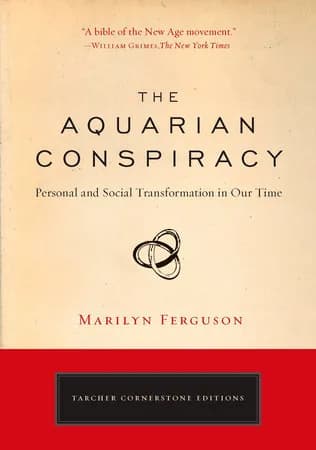
Marilyn Ferguson
Quotes
In the beginning, certainly, most did not set out to change society. In that sense, it is an unlikely kind of conspiracy. But they found that their lives had become revolutions. Once a personal change began in earnest, they found themselves re-thinking everything, examining old assumptions, looking anew at their work and relationships, health, political power and “experts," goals and values.
Conspire, in its literal sense, means "to breathe together." It is an intimate joining. To make clear the benevolent nature of this joining, I chose the word Aquarian.
To make the best of both worlds. Oriental and European, the ancient and modern — what am I saying? To make the best of all the worlds — the worlds already realized within the various cultures and, beyond them, the worlds of still unrealized potentialities.
Gradually Western thinkers were beginning to attack the very foundations of Western thought. We were naive in our expectation that mechanistic science would explain the mysteries of life. These spokesmen for a larger worldview pointed out how our institutions were violating nature: Our education and philosophy failed to value art, feelings, intuition.
"It" has infected medicine, education, social science, hard science, even government with its implications. It is characterized by fluid organizations reluctant to create hierarchical structures, averse to dogma. It operates on the principle that change can only be facilitated, not decreed. It is short on manifestos. It seems to speak to something very old. And perhaps, by integrating magic and science, art and technology, it will succeed where all the king's horses and all the king's men failed.
If we look at the reality of the world from the viewpoint of the industrial era, it is clear that there is no hope But there is another way to look at our situation. We can discover the large number of people who have decided to change. ... If we do this, it seems equally impossible that we shall fail to solve our problems.
In the late 1930s a Polish count, Alfred Korzybski, pointed out yet another aspect of consciousness — language. Language molds thought, he said, laying out the principles of General Semantics. We confuse it with reality; it creates false certainties. With words we try to isolate things that can only exist in continuity. We fail to see process, change, movement. If we are to experience reality, Korzybski and his followers said, we must acknowledge the limits of language.
In a 1940 letter Aldous Huxley said that although he was profoundly pessimistic about collective humanity at the moment, he was "profoundly optimistic about individuals and groups of individuals existing on the margins of society." The British author, living in Los Angeles, was the hub of a kind of pre-Aquarian conspiracy, an international network of intellectuals, artists, and scientists interested in the notion of transcendence and transformation. They disseminated new ideas, supported each other's efforts, and wondered whether anything would ever come of it. Many of Huxley's interests were so advanced that they did not come into their own until the decade after his death. When such ideas were heresies, he was a proponent of consciousness research, decentralization in government and the economy, paranormal healing, the uses of altered awareness, visual retraining, and acupuncture.
Whatever their station or sophistication, the conspirators are linked, made kindred by their inner discoveries and earthquakes. You can break through old limits, past inertia and fear, to levels of fulfillment that once seemed impossible ... to richness of choice, freedom, human closeness. You can be more productive, confident, comfortable with insecurity. Problems can be experienced as challenges, a chance for renewal, rather than stress. Habitual defensiveness and worry can fall away. It can all be otherwise.
The Transcendentalists — Ralph Waldo Emerson, Henry Thoreau, Bronson Alcott, and Margaret Fuller, along with several dozen others — rebelled against what seemed the dead, dry intellectualism of the day. Something was missing — an invisible dimension of reality they sometimes called the Oversoul. They sought understanding from many sources: experience, intuition, the Quaker idea of the Inner Light, the Bhagavad Gita, the German Romantic philosophers, historian Thomas Carlyle, poet Samuel Coleridge, Swedenborg, the English metaphysical writers of the seventeenth century. Their term for intuition was "transcendental reason." They anticipated the consciousness research of our time in their belief that the brain's other mode of knowing is not an alternative to normal reasoning but a kind of transcendent logic — too fast and complex for us to follow with the step-by-step reasoning powers of our everyday consciousness.
In the mid-1950s psychoanalyst Robert Lindner touched off controversy by his prophetic warning that there was an impending "mutiny of the young": Into them we have bred our fears and insecurities, upon them we have foisted our mistakes and misconceptions. In our stead they are expressing the unrelieved rage, the tension, and the terrible frustration of the world they were born into They are imprisoned by the blunders and delusions of their predecessors, and like all prisoners, they are mutineers in their hearts.
Must We Conform? asked the title of a book he wrote in 1956. "The answer is a resounding No! No — not only because in the end we are creatures who cannot . . . but no because there is an alternate way of life available to us here and now. It is the way of positive rebellion, the path of creative protest." The key was enlarged awareness, Lindner said — recognition of how we are crippled by unconscious fears and motives. "I believe profoundly that the tide can be turned."
New perspectives give birth to new historic ages, Humankind has had many dramatic revolutions of understanding — great leaps, sudden liberation from old limits. . . A paradigm is a scheme for understanding and explaining certain aspects of reality. . . Usually at the point of crisis, someone has a great heretical idea. A powerful new insight explains the apparent contradictions. It introduces a new principle — a new perspective.
New paradigms are nearly always received with coolness, even mockery and hostility. The idea may appear bizarre, even fuzzy, at first because the discoverer made an intuitive leap and does not have all the data in place yet.