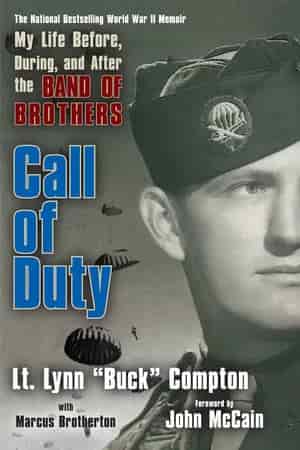
Although I was affected by the horrors of Bastogne, I do not believe I was clinically shell shocked, as the… — Lynn Compton
Although I was affected by the horrors of Bastogne, I do not believe I was clinically shell shocked, as the series portrays me. In real life, while I was hollering for the medic, trying to figure out what to do, I remember two distinct thoughts: How are we going to help the wounded guys?...Maybe this is the time the Germans are really going to get us all.
p. 143Source: Wikiquote · CC BY-SA 4.0
More from this book
As young people, my generation would see a lot of death. I don't think I ever grew accustomed to it. It came in darkness and fervor, by our airplanes, rifles, parachutes, and tanks. But there was something about that first death I experienced the summer of 1939 when I was just eighteen, years before the war, that stayed with me so strongly. Those first few seasons after my father died were dark indeed.
p. 54
Sometimes the greatest signs of strength are demonstrated when you relive the hardest parts of your life. I'm not a man easily given to emotion. I hate to cry. Yet there are three things that cause me to tear up today. One is when I talk about the love I have for America. The second I'll tell you about later in this book. The third is whenever I remember by dad's suicide.
p. 53
Just before Christmas, 1944, we got word that the Germans had closed the circle around Bastogne. This meant that the 101st Airborne was now completely surrounded by the enemy. Dick Winters said once that being surrounded was no problem for paratroopers- we were used to that. For me, it's hard to describe the feeling of isolation. The heavy fog meant that we were cut off from any help from the sky. We were alone, out in the woods, surrounded, with desperately low supplies. We were in day-to-day survival mode. Build the occasional fire. Melt some snow. Find something to eat. Cook it in your helmet. Stay out of harm's way. Just do what you need to do to get through the day.
p. 138