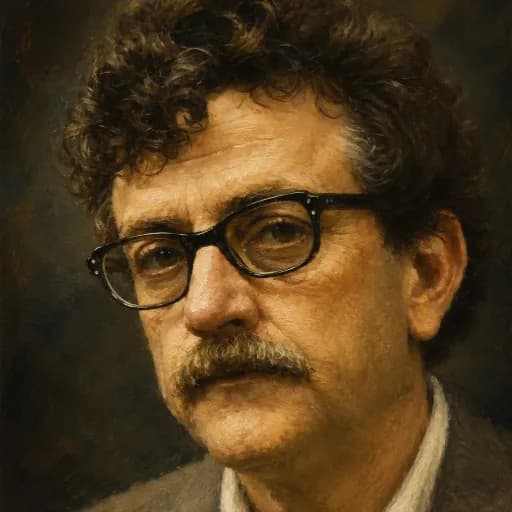
Kurt Vonnegut
Quotes
Anita had the mechanics of marriage down pat, even to the subtlest conventions. If her approach was disturbingly rational, systematic, she was thorough enough to turn out a credible counterfeit of warmth.
p. 25
And as Paul said these things to himself, a wave of sadness washed over them as though they'd been written in sand. He was understanding now that no man could live without roots—roots in a patch of desert, a red clay field, a mountain slope, a rocky coast, a city street. In black loan, in mud or sand or rock or asphalt or carpet, every man had his roots down deep—in home.
p. 227
"You think I'm insane?" said Finnerty. Apparently he wanted more of a reaction than Paul had given him.
"You're still in touch. I guess that's the test."
"Barely — barely."
"A psychiatrist could help. There's a good man in Albany."
Finnerty shook his head. "He'd pull me back into the center, and I want to stay as close to the edge as I can without going over. Out on the edge you see all kinds of things you can't see from the center." He nodded, "Big, undreamed-of things — the people on the edge see them first."
p. 86
"If only it weren't for the people, the goddamned people," said Finnerty, "always getting tangled up in the machinery. If it weren't for them, earth would be an engineer's paradise."
I figured things would be better in Washington, that I'd find a lot of people I admired and belonged with. Washington is worse, Paul—Ilium to the tenth power. Stupid, arrogant, self-congratulatory, unimaginative, humorless men. And the women, Paul—the dull wives feeding on the power and glory of their husbands.
p. 88
And a step backward, after making a wrong turn, is a step in the right direction.
p. 295
These displaced people need something, and the clergy can't give it to them—or it's impossible for them to take what the clergy offers. The clergy says it's enough, and so does the Bible. The people say it isn't enough, and I suspect they're right.
p. 92
During the war, in hundreds of Iliums over America, managers and engineers learned to get along without their men and women, who went to fight. It was the miracle that won the war — production with almost no manpower. In the patois of the north side of the river, it was the know-how that won the war. Democracy owed its life to know-how.
p. 9
Paul wondered at what thorough believers in mechanization most Americans were, even when their lives had been badly damaged by mechanization.
p. 241
When Paul thought about his effortless rise in the hierarchy, he sometimes, as now, felt sheepish, like a charlatan. He could handle his assignments all right, but he didn't have what his father had, what Kroner had, what Shepherd had, what so many had: the sense of spiritual importance in what they were doing; the ability to be moved emotionally, almost like a lover, by the great omnipresent and omniscient spook, the corporate personality. In short, what Paul missed was what made his father aggressive and great: the capacity to really give a damn.
p. 66
The band at the far end of the hall, amplified to the din of an elephant charge, smashed and hewed at the tune as though in a holy war against silence.
p. 188
Everybody's shaking in his boots, so don't be bluffed.
p. 219