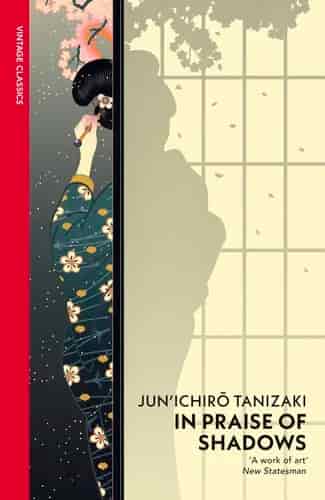
Our ancestors made of woman an object inseparable from darkness, like lacquerware decorated in gold or… — Junichiro Tanizaki
Our ancestors made of woman an object inseparable from darkness, like lacquerware decorated in gold or mother-of-pearl. They hid as much of her as they could in shadows, concealing her arms and legs in the folds of long sleeves and skirts, so that one part and one only stood out — her face. The curveless body may, by comparison with Western women, be ugly. But our thoughts do not travel to what we cannot see. The unseen for us does not exist. The person who insists upon seeing her ugliness, like the person who would shine a hundred-candlepower light upon the picture alcove, drives away whatever beauty may reside there.
p. 30Source: Wikiquote · CC BY-SA 4.0
More from this book
My mother was remarkably slight, under five feet I should say, and I do not think that she was unusual for her time. I can put the matter strongly: women in those days had almost no flesh. I remember my mother's face and hands, I can clearly remember her feet, but I can remember nothing about her body. She reminds me of the statue of Kannon in the Chuguji, whose body must be typical of most Japanese women of the past. The chest as flat as a board, breasts paper-thin, back, hips, and buttocks forming an undeviating straight line, the whole body so lean and gaunt as to seem out of proportion with the face, hands, and feet, so lacking in substance as to give the impression not of flesh but of a stick — must not the traditional Japanese woman have had just such a physique? A few are still about — the aged lady in an old-fashioned household, some few geisha. They remind me of stick dolls, for in fact they are nothing more than poles upon which to hang clothes. As with the dolls their substance is made up of layer upon layer of clothing, bereft of which only an ungainly pole remains. But in the past this was sufficient. For a woman who lived in the dark it was enough if she had a faint, white face — a full body was unnecessary.
p. 29
Whenever I see the alcove of a tastefully built Japanese room, I marvel at our comprehension of the secrets of shadows, our sensitive use of shadow and light. For the beauty of the alcove is not the work of some clever device. An empty space is marked off with plain wood and plain walls, so that the light drawn into it forms dim shadows within emptiness. There is nothing more. And yet, when we gaze into the darkness that gathers behind the crossbeam, around the flower vase, beneath the shelves, though we know perfectly well it is mere shadow, we are overcome with the feeling that in this small comer of the atmosphere there reigns complete and utter silence; that here in the darkness immutable tranquility holds sway.
p. 29
Were it not for shadows, there would be no beauty.
p. 30