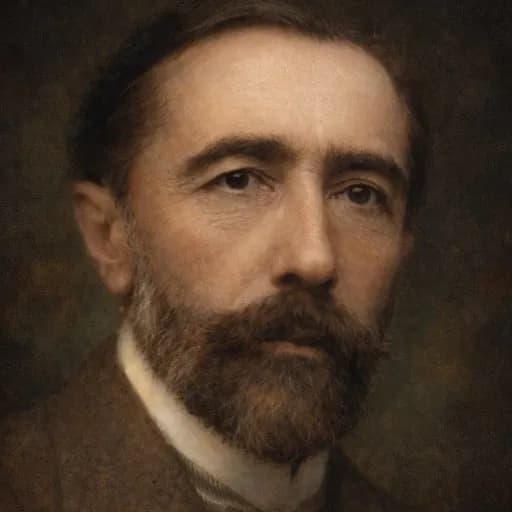
Joseph Conrad
Quotes
They talk of a man betraying his country, his friends, his sweetheart. There must be a moral bond first. All a man can betray is his conscience.
A man's most open actions have a secret side to them.
I had been six years at sea, but had only seen Melbourne and Sydney, very good places, charming places in their way — but Bankok!
Only a moment; a moment of strength, of romance, of glamour — of youth!... A flick of sunshine upon a strange shore, the time to remember, the time for a sigh, and — goodbye! — Night — Goodbye!
Having had to encounter single-handed during his period of eclipse many physical dangers, he was well aware of the most dangerous element common to them all: of the crushing, paralyzing sense of human littleness, which is what really defeats a man struggling with natural forces, alone, far from the eyes of his fellows.
A nickname may be the best record of a success. That's what I call putting the face of a joke upon the body of a truth.
There is no peace and no rest in the development of material interests. They have their law, and their justice. But it is founded on expediency, and is inhuman; it is without rectitude, without the continuity and the force that can be found only in a moral principal.
His name was Jermyn, and he dodged all day long about the galley drying his handkerchief before the stove. Apparently he never slept. He was a dismal man, with a perpetual tear sparkling at the end of his nose, who either had been in trouble, or was in trouble, or expected to be in trouble — couldn't be happy unless something went wrong. He mistrusted my youth, my common-sense, and my seamanship, and made a point of showing it in a hundred little ways. I dare say he was right. It seems to me I knew very little then, and I know not much more now; but I cherish a hate for that Jermyn to this day.
Action is consolatory. It is the enemy of thought and the friend of flattering illusions.
I remember my youth and the feeling that will never come back any more — the feeling that I could last for ever, outlast the sea, the earth, and all men; the deceitful feeling that lures us on to joys, to perils, to love, to vain effort — to death; the triumphant conviction of strength, the heat of life in the handful of dust, the glow in the heart that with every year grows dim, grows cold, grows small, and expires — and expires, too soon — too soon before life itself.
The truth was that he died from solitude, the enemy known but to few on this Earth, and whom only the simplest of us are fit to withstand. The brilliant Costaguanaro of the boulevards had died from solitude and want of faith in himself and others.
The imbecile bourgeoisie of this country make themselves the accomplices of the very people whose aim is to drive them out of their houses to starve in ditches. And they have the political power still, if they only had the sense to use it for their preservation.