

John Sweeney
Quotes
He was shot in the back of the back several times one hundred metres or so from the walls of the Kremlin, one of the most closely CCTV-filmed areas on earth. The official narrative was that a bin lorry obscured the Kremlin's cameras from capturing the killer or killers. Attentive readers will have already got it, but for the avoidance of any doubt the official narrative is a load of old hogwash. In my four decades-plus of reporting, I have never been detained by police officers more often than outside the Kremlin. You cannot move five yards without a cop demanding to see your passport. The idea that Nemtsov was assassinated but that none of the Kremlin's cameras captured critical evidence is absurd.
p. 174
 Killer in the Kremlin
When Putin stole Crimea back in 2014, he ripped up the order established after 1945, secured by NATO and what became the European Union, that there would be no more land grabs in Europe. Putin, his 1970s secret policemen sunglasses blinkering his vision, doesn't get it that he is reheating Hitler's chip. The move was hugely popular inside Russia and that caused Navalny, always with an ear for the mood of the Russian electorate, a major headache. Side with Putin on Crimea, and Navalny would keep in with the Russian public but fall out with Ukraine and the international rules-based order; side with Ukraine and, he feared, he would lose relevance back home.
p. 123
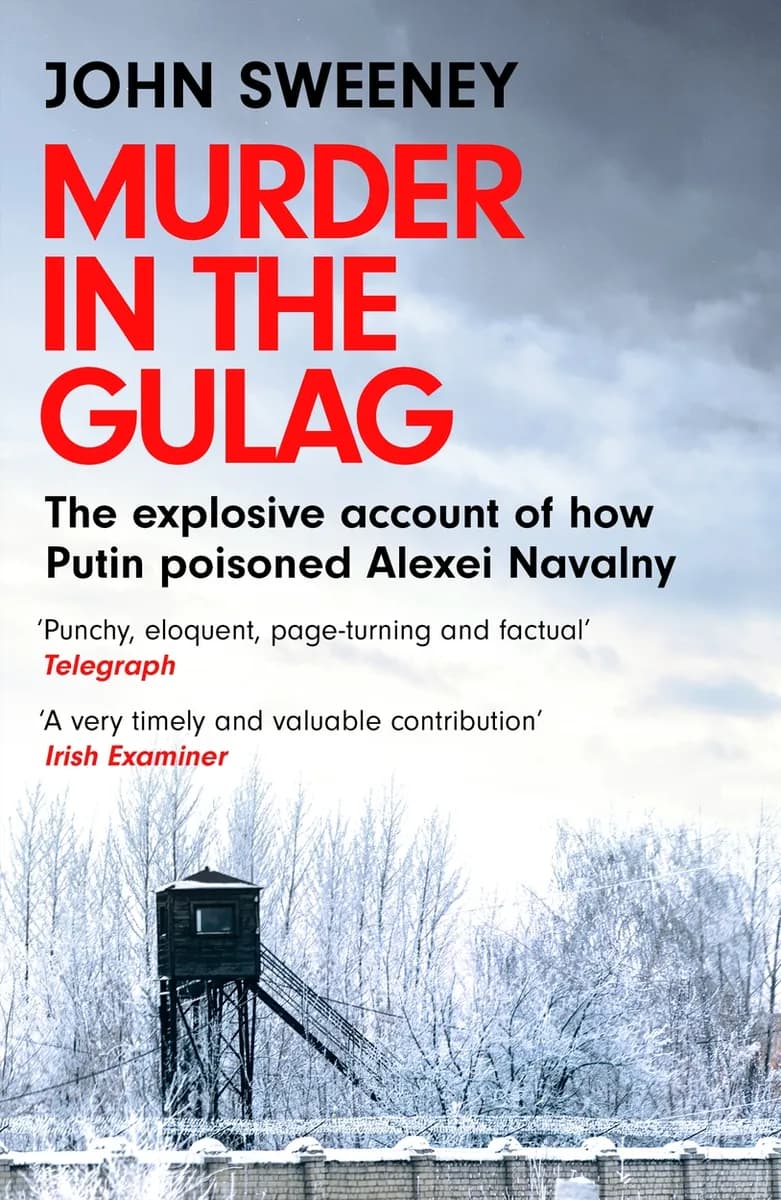 Murder in the Gulag
What remains extraordinary about the Salisbury poisonings is the seeming stupidity of it. How so? Novichok is, like polonium-210, a very expensive poison. The two murderers were sent to Salisbury with their poison bottle but with no regard to the simple fact of modern British life, that the country is littered with six million CCTV cameras, more units per person than any other country apart from China. Whoever sent the GRU officers is a fool. Reflecting on this anomaly – multi-million-dollar secret poison delivered on candid camera – makes me draw a harsh and, perhaps, novel conclusion about the Russian secret state in the twenty-first century. [...] The ideological power of Communism's appeal [...] is long dead; so, too, is its darkest enemy, Hitler; so, too, is the state that created the KGB. In its place you have the Russian Federation, an ethno-nationalist kleptocracy run by a pleonexiac with too long a table. The West should not be surprised that the quality of the servants of the Russian secret state in the twenty-first century is, frankly, a bit rubbish.
p. 200
Killer in the KremlinIt is fair to say that the Russian secret state succeeded in getting worryingly close to serious political leaders in the United States, Britain, Germany, France and Italy. Time and again the Kremlin turned Western democracy into a game of matryoshka dolls. Lift out the Donald Trump or Nigel Farage or Jeremy Corbyn or Matteo Salvini or Marine Le Pen dolls, and you come face to face with Vladimir Putin – smirking at you.
p. 231
Killer in the KremlinI say it to my Ukrainian friends again and again: there is another Russia. The problem is that the alternatives to Vladimir Putin are either dead or not very alive.
p. 175
Killer in the KremlinWith the benefit of hindsight, the two outstanding qualities of Medvedev for Putin's benison are that he is the shorter man and that he would never dream of saying boo to the boss. [...] For a time, Medvedev steered or appeared to steer a path to a different future. That was a charade. In fact, he owed fealty to Putin. What you got was liberal lipstick but fascist substance. For far too long, the West went along with Medvedev's schtick as a reformer with an interest in new tech, blah blah, blah blah.
p. 62
Murder in the GulagThe break-up of the European Union is a Kremlin goal and Brexit was a great Kremlin success.
p. 244
Killer in the KremlinRussia does not tolerate failure for long. My sense is that Vladimir Putin no longer properly controls the machinery of the Kremlin in the way that he did at the start of 2022. And that the Kremlin machines no longer obey their master as before. He's beginning to look like the Wizard of Oz. All we are waiting for is the little dog to pull aside the curtain, and the shrunken faker bellowing into a loudhailer will be revealed to all.
p. 275
Killer in the KremlinAs American and British politicians slowly began to see Putin for who he really was, Corbyn decided to echo, albeit in a faltering and weak voice, some of the Kremlin's messaging. This was because he was navigating simply by holding himself in constant opposition to American power. By doing so, he made himself yet another of the Kremlin's useful idiots. George Osborne and Peter Mandelson cosied up to Kremlin proxies for their own self-interest; Corbyn lost his bearings because his political ideology was so strong it twisted reality.
p. 239
Killer in the KremlinFor the avoidance of doubt, I do not believe that the evidence is anything like strong enough to call Vladimir Putin a paedophile. True, in the summer of 2006 he got out of his Kremlin motorcade, walked a few hundred yards, came across a slight, blond young Russian boy, knelt before him, lifted up his T-shirt and kissed him on the stomach, patted him on the head and then hurried off to his high castle. You can see it on YouTube here: https://www.youtube.com/watch?v=5uWEaKLzwUg
It is beyond creepy but that one instance is not enough to jump to the conclusion that Putin is a paedophile. Alexander Litvinenko was the former KGB colonel who clashed bitterly with Putin over corruption inside the renamed FSB, so much so that he had to flee the country for London. After he saw this video, he wrote a blog, alleging that the reason that Putin got a poor posting when he started out in the KGB was because the high-ups discovered he was a paedophile and felt they could not trust him to serve in the West, so he had to work first in Leningrad, now St Petersburg, then Dresden in East Germany where they could keep an eye on him. Litvinenko cited sources, old KGB officers, for this allegation, but he never came up with any written or other corroborating evidence. Artyom Borovik and Antonio Russo are believed to have been working on the 'Putin may be a paedo' story before they were killed in 2000.
Once again, Putin's fog machine is working full blast here. Of course, there are many other reasons why these three men could have been killed. But both Paul Joyal, a former US intelligence analyst, and I are confident that Litvinenko was poisoned with Polonium 210 because he blogged that Putin was a paedophile.
p. 81
Murder in the GulagWhat was supposed to be a safety test at the number four reactor at the Chernobyl nuclear power plant in April 1986 was the sickest of jokes. The RMBK reactor was the Soviet solution to big oil prices. But it had a series of horrible design flaws. It couldn't tell its operators what was really happening in its guts. Operators could turn a valve by moving a helm-sized wheel and not know whether this would make things more or less dangerous. And the designers' safety test could could lead to a disastrous chain reaction which boiled the nuclear kettles. That had happened eleven years before in 1975 in Soviet Leningrad, now St Petersburg, when Putin was just starting his career inside the KGB in his home city. The secretive Soviet state covered up the huge leak of radiation. The exposed population were not told of the danger. The accident was not reported in the media. The Ministry of Medium Machine Building blamed the accident on poor construction, not terrible design. The commission investigating the incident made several recommendations. None were implemented. No one complained because no one knew. Welcome to the Soviet Union.
p. 19
Murder in the GulagThe fall of the Soviet Union delivered real change. The old nonesense of Communism did start to die, but far more slowly than appreciated back then. Ordinary Russians for the first time in their lives could read honest newspapers, watch good telly, go abroad, buy fancy foreign cars, own their own homes. The idea of a free market was embraced, but a system without the functioning machinery of the rule of law was bound to struggle. The rhetoric of a free market masked the reality of a bloody anarchy where the people who came out on top were the most cunning, the most pitiless and the greediest. Russia turned into an oligarchy, the country's resources carved up and seized by a few rich men, but an oligarchy with democratic lipstick. [...] The problem was that political power was in the wrong hands. As the nineties wore on, Boris Yeltsin morphed from being an inspirational and courageous leader, willing to stand up on a tank to defend Russia's infant democracy, into a senile alcoholic, guarded by some of his hopelessly corrupt family. The president of Russia needed to be fighting like a tiger to stand up for the rule of law, to defend democratic principles, to strengthen Russia's fragile open society. Instead, he took the pith.
p. 32
Murder in the Gulag

