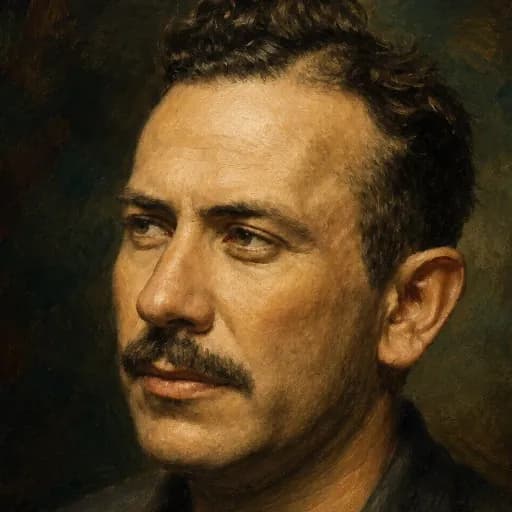
John Steinbeck
Quotes
This is the thing to bomb. This is the beginning—from "I" to "we". If you who own the things people must have could understand this, you might preserve yourself. If you could separate causes from results, if you could know that Paine, Marx, Jefferson, Lenin were results, not causes, you might survive. But that you cannot know. For the quality of owning freezes you forever into "I", and cuts you off forever from the "we".
p. 152
The bank is something else than men. It happens that every man in a bank hates what the bank does, and yet the bank does it. The bank is something more than men, I tell you. It's the monster. Men made it, but they can't control it.
Tom grinned. "It don’t take no nerve to do somepin when there ain’t nothin’ else you can do."
p. 231
The tenant pondered. "Funny thing how it is. If a man owns a little property, that property is him, it's part of him, and it's like him. If he owns property only so he can walk on it and handle it and be sad when it isn't doing well, and feel fine when the rain falls on it, that property is him, and some way he's bigger because he owns it. Even if he isn't successful he's big with his property. That is so."
And the tenant pondered more. "But let a man get property he doesn't see, or can't take time to get his fingers in, or can't be there to walk on it—why, then the property is the man. He can't do what he wants, he can't think what he wants. The property is the man, stronger than he is. And he is small, not big. Only his possessions are big—and he's the servant of his property. That is so, too.
If you're in trouble or hurt or need—go to poor people. They're the only ones that'll help—the only ones.
p. 376
If a bank or a finance company owned the land, the owner man said, The Bank — or the Company — needs — wants — insists — must have — as though the Bank or the Company were a monster, with thought and feeling, which had ensnared them. These last would take no responsibility for the banks or the companies because they were men and slaves, while the banks were machines and masters all at the same time. Some of the owner men were a little proud to be slaves to such cold and powerful masters.
To California or any place—every one a drum major leading a parade of hurts, marching with our bitterness. And some day—the armies of bitterness will all be going the same way. And they'll all walk together, and there'll be a dead terror from it.
p. 91
The land company — that's the bank when it has land — wants tractors, not families on the land. Is a tractor bad? Is the power that turns the long furrows wrong? If this tractor were ours it would be good — not mine, but ours. If our tractor turned the long furrows of our land, it would be good. Not my land, but ours. We could love that tractor then as we have loved this land when it was ours. But this tractor does two things — it turns the land and turns us off the land. There is little difference between this tractor and a tank. The people are driven, intimidated, hurt by both.
Prayer never brought in no side-meat. Takes a shoat to bring in pork.
How can we live without our lives? How will we know it’s us without our past?
The works of the roots of the vines, of the trees, must be destroyed to keep up the price, and this is the saddest, bitterest thing of all. Carloads of oranges dumped on the ground. The people came for miles to take the fruit, but this could not be. How would they buy oranges at twenty cents a dozen if they could drive out and pick them up? And men with hoses squirt kerosene on the oranges, and they are angry at the crime, angry at the people who have come to take the fruit. A million people hungry, needing the fruit—and kerosene sprayed over the golden mountains.
And the smell of rot fills the country.
Burn coffee for fuel in the ships. Burn corn to keep warm, it makes a hot fire. Dump potatoes in the rivers and place guards along the banks to keep the hungry people from fishing them out. Slaughter the pigs and bury them, and let the putrescence drip down into the earth.
There is a crime here that goes beyond denunciation. There is a sorrow here that weeping cannot symbolize. There is a failure here that topples all our success. The fertile earth, the straight tree rows, the sturdy trunks, and the ripe fruit. And children dying of pellagra must die because a profit cannot be taken from an orange. And coroners must fill in the certificates—died of malnutrition—because the food must rot, must be forced to rot.
The people come with nets to fish for potatoes in the river, and the guards hold them back; they come in rattling cars to get the dumped oranges, but the kerosene is sprayed. And they stand still and watch the potatoes float by, listen to the screaming pigs being killed in a ditch and covered with quicklime, watch the mountains of oranges slop down to a putrefying ooze; and in the eyes of the people there is the failure; and in the eyes of the hungry there is a growing wrath. In the souls of the people the grapes of wrath are filling and growing heavy, growing heavy for the vintage.
The driver sat in his iron seat and he was proud of the straight lines he did not will, proud of the tractor he did not own or love, proud of the power he could not control. And when that crop grew, and was harvested, no man had crumbled a hot clod in his fingers and let the earth sift past his fingertips. No man had touched the seed, or lusted for the growth. Men ate what they had not raised, had no connection with the bread. The land bore under iron, and under iron gradually died; for it was not loved or hated, it had no prayers or curses.