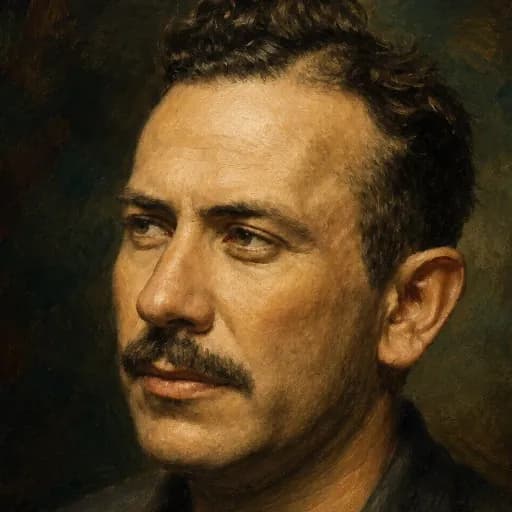
John Steinbeck
Quotes
You ain't worth a greased lack pin to ram you into hell.
p. 101
"Well, that glove's fulla vaseline."
"Vaseline? What the hell for?"
"Well, I tell ya what — Curley says he's keepin' that hand soft for his wife."
p. 29
A powerful, big-stomached man came into the bunkhouse.
p. 35
They come, an' they quit an' go on; an' every damn one of 'em's got a little piece of land in his head. An' never a God damn one of 'em ever gets it. Just like heaven. Ever'body wants a little piece of lan'. I read plenty of books out here. Nobody never gets to heaven, and nobody gets no land. It's just in their head.
p. 74
Death is a personal matter, arousing sorrow, despair, fervor, or dry-hearted philosophy. Funerals, on the other hand, are social functions. Imagine going to a funeral without first polishing the automobile. Imagine standing at a graveside not dressed in your best dark suit and your best black shoes, polished delightfully. Imagine sending flowers to a funeral with no attached card to prove you had done the correct thing. In no social institution is the codified ritual of behavior more rigid than in funerals. Imagine the indignation if the minister altered his sermon or experimented with facial expression. Consider the shock if, at the funeral parlors, any chairs were used but those little folding yellow torture chairs with the hard seats. No, dying, a man may be loved, hated, mourned, missed; but once dead he becomes the chief ornament of a complicated and formal social celebration.
He was very rich, he bought eggs to throw at a Chinaman. And one of those eggs missed the Chinaman and hit a policeman. So, Danny was in jail.
What pillow can one have like a good conscience?
We could live offa the fatta the lan’.
p. 57
"It has always seemed strange to me," said Doc. "The things we admire in men, kindness and generosity, openness, honesty, understanding and feeling are the concomitants of failure in our system. And those traits we detest, sharpness, greed, acquisitiveness, meanness, egotism and self-interest are the traits of success."
It was a glorious game. Theft robbed of the stigma of theft, crime altruistically committed—what is more gratifying?
Cannery Row in Monterey in California is a poem, a stink, a grating noise, a quality of light, a tone, a habit, a nostalgia, a dream.
Ain't many guys travel around together. I don’t know why. Maybe ever’body in the whole damn world is scared of each other.
p. 35