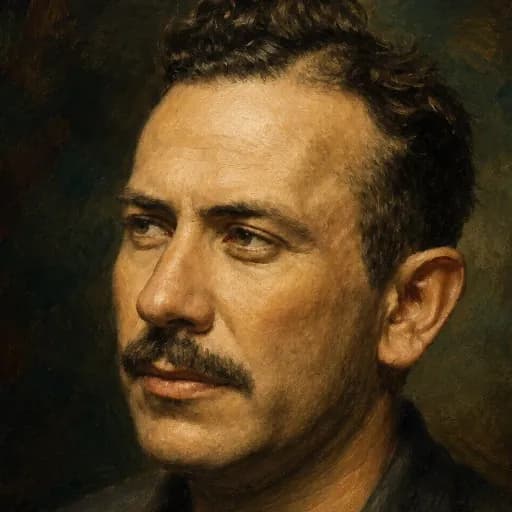
John Steinbeck
Quotes
Our species is the only creative species, and it has only one creative instrument, the individual mind and spirit of a man. Nothing was ever created by two men. There are no good collaborations, whether in art, in music, in poetry, in mathematics, in philosophy. Once the miracle of creation has taken place, the group can build and extend it, but the group never invents anything. The preciousness lies in the lonely mind of a man.
And now the forces marshaled around the concept of the group have declared a war of extermination on that preciousness, the mind of man. By disparagement, by starvation, by repressions, forced direction, and the stunning blows of conditioning, the free, roving mind is being pursued, roped, blunted, drugged. It is a sad suicidal course our species seems to have taken.
And this I believe: that the free, exploring mind of the individual human is the most valuable thing in the world. And this I would fight for: the freedom of the mind to take any direction it wishes, undirected. And this I must fight against: any religion, or government which limits or destroys the individual. This is what I am and what I am about. I can understand why a system built on a pattern must try to destroy the free mind, for it is the one thing which can by inspection destroy such a system. Surely I can understand this, and I hate it and I will fight against it to preserve the one thing that separates us from the uncreative beasts. If the glory can be killed, we are lost.
What freedom men and women could have, were they not constantly tricked and trapped and enslaved and tortured by their sexuality! The only drawback in that freedom is that without it one would not be a human. One would be a monster.
Is it true that when you love a woman you are never sure — never sure of her because you aren’t sure of yourself?
p. 69
He brought his malformed wisdom, his pool-hall, locker-room, joke-book wisdom to the front.
For it is said that humans are never satisfied, that you give them one thing and they want something more. And this is said in disparagement, whereas it is one of the greatest talents the species has and one that has made it superior to animals that are satisfied with what they have.
A plan is a real thing, and things projected are experienced. A plan once made and visualized becomes a reality along with other realities—never to be destroyed but easily to be attacked.
"When you argue with a child," she said warmly, "you give a good argument and the child says yah, yah! You understand him and he doesn't listen, so the child wins."
He was a fine steady man, Juan Chicoy, part Mexican and part Irish, perhaps fifty years old, with clear black eyes, a good head of hair, and a dark and handsome face. Mrs Chicoy was insanely in love with him and a little afraid of him too, because he was a man, and there aren't very many of them, as Alice Chicoy had found out. There aren't very many of them in the world, as everyone finds out sooner or later.
For every man in the world functions to the best of his ability, and no one does less than his best, no matter what he may think about it.
He wondered why he stayed with her. Just pure laziness, he guessed. He didn't want to go through the emotional turmoil of leaving her. In spite of himself he'd worry about her and it was too much trouble. He'd need another woman right away and that took a lot of talking and arguing and persuading. It was different just to lay a girl but he would need a woman around, and that was the difference. You got used to one and it was less trouble.[…]
But there was another reason too. She loved him. She really did. And he knew it. And you can't leave a thing like that. It's a structure and it has an architecture, and you can't leave it without tearing off a piece of yourself. So if you want to remain whole you stay no matter how much you may dislike staying. Juan was not a man who fooled himself very much.
Mr. Pritchard was a businessman, president of a medium-sized corporation. He was never alone. His business was conducted by groups of men like himself who joined together in clubs so that no foreign element or idea could enter. His religious life was again his lodge and his church, both of which were screened and protected. One night a week he played poker with men so exactly like himself that the game was fairly even, and from this fact his group was convinced that they were very fine poker players. Wherever he went he was not one man but a unit in a corporation, a unit in a club, in a lodge, in a church, in a political party. His thoughts and ideas were never subjected to criticism since he willingly associated only with people like himself. He read a newspaper written by and for his group. The books that came into his house were chosen by a committee which deleted material that might irritate him. He hated foreign countries and foreigners because it was difficult to find his counterpart in them. He did not want to stand out from his group. He would like to have risen to the top of it and be admired by it; but it would not occur to him to leave it. At occasional stags where naked girls danced on the tables and sat in great glasses of wine, Mr. Pritchard howled with laughter and drank the wine, but five hundred Mr. Pritchards were there with him.
He had said, "I am a man," and that meant certain things to Juana. It meant that he was half insane and half god. It meant that Kino would drive his strength against a mountain and plunge his strength against the sea. Juana, in her woman's soul, knew that the mountain would stand while the man broke himself; that the sea would surge while the man drowned in it. And yet it was this thing that made him a man, half insane and half god, and Juana had need of a man; she could not live without a man. Although she might be puzzled by these differences between man and woman, she knew them and accepted them and needed them. Of course she would follow him, there was no question of that. Sometimes the quality of woman, the reason, the caution, the sense of preservation, could cut through Kino's manness and save them all.