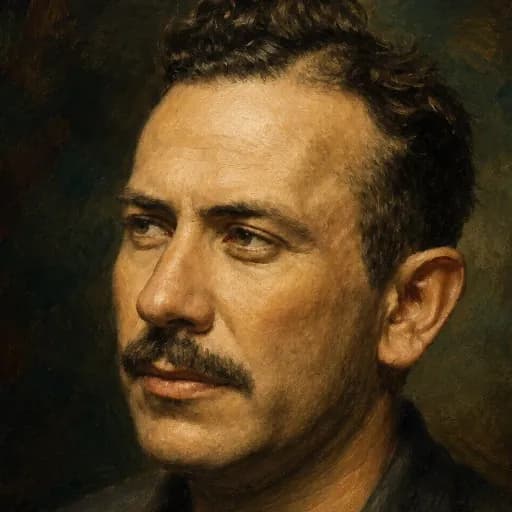
John Steinbeck
Quotes
That's why I'm talking to you. You are one of the rare people who can separate your observation from your preconception. You see what is, where most people see what they expect.
p. 161
There are no ugly questions except those clothed in condescension.
p. 163
Every man has a retirement picture in which he does those things he never had time to do — makes journeys, reads the neglected books he always pretended to have read.
p. 559
Can you think that whatever made us — would stop trying?
p. 599
It was well known that Liza Hamilton and the Lord God held similar convictions on nearly every subject.
p. 178
Among primitives sometimes evil is escaped by never mentioning the name, as in Malaysia, where one never mentions a tiger by name for fear of calling him. Among others, as even among ourselves, the giving of a name establishes a familiarity which renders the thing impotent. It is interesting to see how some scientists and philosophers, who are an emotional and fearful group, are able to protect themselves against fear. In a modern scene, when the horizons stretch out and your philosopher is likely to fall off the world like a Dark Age mariner, he can save himself by establishing a taboo-box which he may call "mysticism" or "supernaturalism" or "radicalism." Into this box he can throw all those thoughts which frighten him and thus be safe from them.
"Let us go," we said, "into the Sea of Cortez, realizing that we become forever a part of it; that our rubber boots slogging through a flat of eel-grass, that the rocks we turn over in a tide pool, make us truly and permanently a factor in the ecology of the region. We shall take something away from it, but we shall leave something too." And if we seem a small factor in a huge pattern, nevertheless it is of relative importance. We take a tiny colony of soft corals from a rock in a little water world. And that isn't terribly important to the tide pool. Fifty miles away the Japanese shrimp boats are dredging with overlapping scoops, bringing up tons of shrimps, rapidly destroying the species so that it may never come back, and with the species destroying the ecological balance of the whole region. That isn't very important in the world. And thousands of miles away the great bombs are falling and the stars are not moved thereby. None of it is important or all of it is.
We are no better than the animals; in fact in a lot of ways we aren't as good.
We sat on a crate of oranges and thought what good men most biologists are, the tenors of the scientific world — temperamental, moody, lecherous, loud-laughing, and healthy.[…] Your true biologist will sing you a song as loud and off-key as will a blacksmith, for he knows that morals are too often diagnostic of prostatitis and stomach ulcers. Sometimes he may proliferate a little too much in all directions, but he is as easy to kill as any other organism, and meanwhile he is very good company, and at least he does not confuse a low hormone productivity with moral ethics.
His guard was up now and he wasn't listening; he was only angry because here was a world he could not enter and so he had to disbelieve in its existence. He fell back on the world he knew.
Some...forces seem evil to us, perhaps not in themselves but because their tendency is to eliminate the things we hold good.
p. 130
I’ll have you know that a soldier is the most holy of all humans because he is the most tested — most tested of all. I’ll try to tell you. Look now — in all of history men have been taught that killing of men is an evil thing not to be countenanced. Any man who kills must be destroyed because this is a great sin, maybe the worst sin we know. And then we take a soldier and put murder in his hands and we say to him, “Use it well, use it wisely.” We put no checks on him. Go out and kill as many of a certain kind or classification of your brothers as you can. And we will reward you for it because it is a violation of your early training.
p. 24