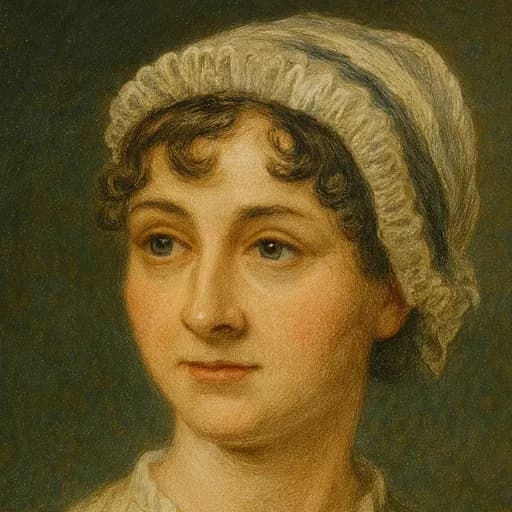
Jane Austen
Quotes
'I cannot make speeches, Emma:' he soon resumed; and in a tone of such sincere, decided, intelligible tenderness as was tolerably convincing.—'If I loved you less, I might be able to talk about it more. But you know what I am.—You hear nothing but truth from me.—I have blamed you, and lectured you, and you have borne it as no other woman in England would have borne it.—Bear with the truths I would tell you now, dearest Emma, as well as you have borne with them. The manner, perhaps, may have as little to recommend them. God knows, I have been a very indifferent lover.—But you understand me.—Yes, you see, you understand my feelings—and will return them if you can. At present, I ask only to hear, once to hear your voice.'
It was badly done, indeed! You, whom she had known from an infant, whom she had seen grow up from a period when her notice was an honour, to have you now, in thoughtless spirits, and the pride of the moment, laugh at her, humble her–and before her niece, too–and before others, many of whom (certainly some,) would be entirely guided by your treatment of her.–This is not pleasant to you, Emma–and it is very far from pleasant to me; but I must, I will,–I will tell you truths while I can.
I do not know whether it ought to be so, but certainly silly things do cease to be silly if they are done by sensible people in an impudent way. Wickedness is always wickedness, but folly is not always folly.—It depends upon the character of those who handle it. Mr. Knightley, he is not a trifling, silly young man. If he were, he would have done this differently. He would either have gloried in the achievement, or been ashamed of it. There would have been either the ostentation of a coxcomb, or the evasions of a mind too weak to defend its own vanities.—No, I am perfectly sure that he is not trifling or silly.
A man would always wish to give a woman a better home than the one he takes her from; and he who can do it, where there is no doubt of her regard, must, I think, be the happiest of mortals.
Can you trust me with such flatterers?—Does my vain spirit ever tell me I am wrong?
What did she say? Just what she ought, of course. A lady always does. She said enough to show there need not be despair – and to invite him to say more himself.
"“The death of your daughter would have been a blessing in comparison of this … They agree with me in apprehending that this false step in one daughter will be injurious to the fortunes of all the others; for who, as Lady Catherine herself condescendingly says, will connect themselves with such a family?”
"When I consider," she added, in a yet more agitated voice, "that I might have prevented it! — I who knew what he was. Had I but explained some part of it only — some part of what I learnt — to my own family! Had his character been known, this could not have happened. But it is all, all too late now."
"Loss of virtue in a female is irretrievable; that one false step involves her in endless ruin; that her reputation is no less brittle than it is beautiful; and that she cannot be too much guarded in her behaviour towards the undeserving of the other sex.”
"Mr. Darcy, you see, is the man! Now, Lizzy, I think I have surprised you. Could he, or the Lucases, have pitched on any man within the circle of our acquaintance, whose name would have given the lie more effectually to what they related? Mr. Darcy, who never looks at any woman but to see a blemish, and who probably never looked at you in his life! It is admirable!"
Elizabeth tried to join in her father's pleasantry, but could only force one most reluctant smile. Never had his wit been directed in a manner so little agreeable to her."
"You have said quite enough, madam. I perfectly comprehend your feelings, and have now only to be ashamed of what my own have been. Forgive me for having taken up so much of your time, and accept my best wishes for your health and happiness."
"Mrs. Bennet had no turn for economy; and her husband's love of independence had alone prevented their exceeding their income."