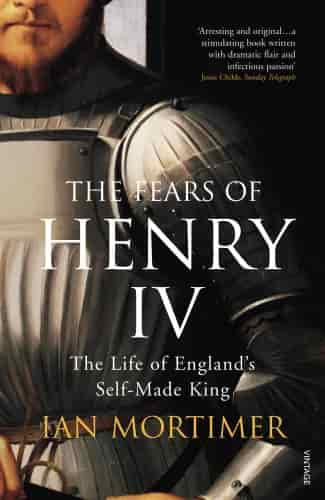
Ian Mortimer
Quotes
Such a mercurial ruler could hardly be an inspiration to his people. Wise men do not follow leaders whom they suspect might later reproach them for their loyalty.
p. 137
 The Fears of Henry IV
Knowing that he had no respect for opponents who held high office in the Church allows us to contextualise his piety and see a direct link between his God and himself, thereby largely circumventing the role of the clergy. His attitude towards the prelates he executed was that they deserved no special treatment if they stood in the way of God’s will that Henry should rule England. Hence the apparent contradiction of a pious king who executed an archbishop is explained, and a much fuller picture of his religious conscience obtained.
p. 354
The Fears of Henry IVIf the Lords Appellant are viewed as a group, there is a little doubt that they used tyrannical methods to bring an end to Richard’s tyranny. Their definition of treason, like Richard’s own, bore no resemblance to the articles of the Statute of Treason drawn up by Edward III. Their processes were based largely on military strength, not the law. Their judgement was in places arbitrary and often prejudiced.
p. 78
The Fears of Henry IVThus there were good political reasons why Henry should not have killed Richard. This is not to say that he did not give the order, only to remind us that one cannot judge innocence or guilt on the strength of motive alone.
p. 211
The Fears of Henry IVThe king was purposefully creating the maximum amount of fear. In Richard’s mind, the fear of his subjects equated to his own sense of power.
p. 141
The Fears of Henry IVThis is how Henry could have convinced himself that he was innocent of the murder in the eyes of God. Others had ‘executed’ him, his death being a consequence of the plot to free him. Thus Henry was able to deny his guilt by refusing to accept personal responsibility for what had been a political act carried out for the security of the kingdom. Politicians in all ages have felt similarly inclined to draw a line between public expediency and personal conscience.
p. 259
The Fears of Henry IVVery clearly, Henry cared more for God than for the Church, and more for the Church than for some of the men who exercised office within it.
p. 354
The Fears of Henry IVThe bureaucracy which had stopped functioning since 9 August [1399] started slowly to regain its usual efficiency. The civil servants knew who and where their king was, and they knew in whom sovereign power lay. That these two facts were not embodied in the same man was not essential for them to do their work.
p. 181
The Fears of Henry IVProphecies were searched out in old chronicles and reinterpreted to show that it was God’s will that Henry should put an end to Richard’s rule. He was universally regarded as the champion of the Church and the people, a rescuer of good government and a promise of better times to come.
Yet Henry’s position was far from safe. He had not faced the king, and thus the kingdom had not yet had to choose between the good government he promised and the legitimate government represented by Richard….Which path would the kingdom choose: tyranny in the name of loyalty? Or treason in the name of justice?
p. 177
The Fears of Henry IVThe language of the charges against Richard is certainly legalistic but the message overall was clearly Henry’s. On many matters of justice, Richard had acted in a selfish and arbitrary way, like a spoilt child. After thirty-three counts of tyranny, perjury, misappropriation of funds, murder, harassment, maintenance, toleration of violence and rape committed by his Cheshire archers, deception, dishonesty, theft, wrongful imprisonment (contrary to the terms of Magna Carta) and the removal from office and exile of the archbishop of Canterbury without trial – nearly all of which are supported by damning evidence extant today – there was no doubt in anyone’s mind that the man they were removing was one of the worst rulers England had ever known.
p. 190
The Fears of Henry IVThe most important element of Henry’s kingship was his intention to end his cousin’s experiment in autocratic rule.
p. 196
The Fears of Henry IVJustice was a much more complicated issue. Many people at that parliament wanted Richard to be put to death. Many more wanted those who had benefited from his reign to be punished as traitors. Part of the problem was that the very concept of treason had been greatly enlarged by Richard to encompass anyone who dared disagree with him: in Richard’s own words ‘he is a child of death who offends the king’.
p. 199
The Fears of Henry IV