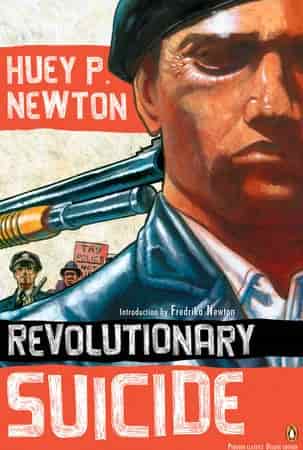
I do not think life will change for the better without an assault on the establishment, which goes on… — Huey P. Newton
I do not think life will change for the better without an assault on the establishment, which goes on exploiting the wretched of the earth. This belief lies at the heart of the concept of revolutionary suicide. Thus it is better to oppose the forces that would drive me to self-murder than to endure them. Although I risk the likelihood of death, there is at least the possibility, if not the probability, of changing intolerable conditions.
p. 3Source: Wikiquote · CC BY-SA 4.0
More from this book
Some see our struggle as a symbol of the trend toward suicide among Blacks. Scholars and academics, in particular, have been quick to make this accusation. They fail to perceive differences. Jumping off a bridge is not the same as moving to wipe out the overwhelming force of an oppressive army. When scholars call our actions suicidal, they should be logically consistent and describe all historical revolutionary movements in the same way. Thus the American colonialists, the French of the late eighteenth century, the Russians of 1917, the Jews of Warsaw, the Cubans, the NLF, the North Vietnamese—any people who struggle against a brutal and powerful force—are suicidal.
p. 5
The first lesson a revolutionary must learn is that he is a doomed man. Unless he understands this, he does not grasp the essential meaning of his life.
p. 3
Revolutionary suicide does not mean that I and my comrades have a death wish; it means just the opposite. We have such a strong desire to live with hope and human dignity that existence without them is impossible. When reactionary forces crush us, we must move against these forces, even at the risk of death.
p. 3