We moderns are not interested in a hero’s pathology or family history, nor in his drives, his digestion, and… — Hermann Hesse
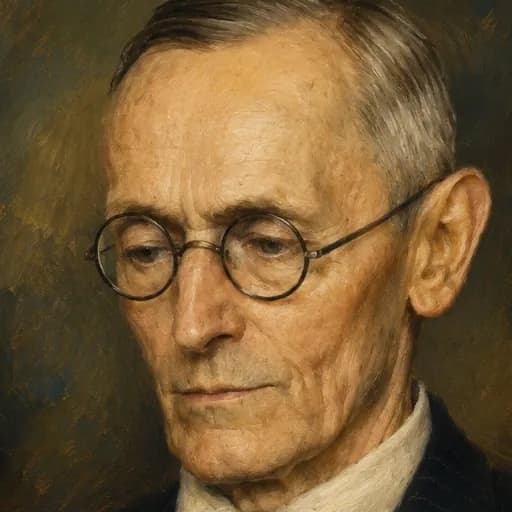
We moderns are not interested in a hero’s pathology or family history, nor in his drives, his digestion, and how he sleeps. Not even his intellectual background—the influence upon his development of his favorite studies, favorite reading, and so on—is particularly important to us. For us, a man is a hero and deserves special interest only if his nature and his education have rendered him able to let his individuality be almost perfectly absorbed in its hierarchic function without at the same time forfeiting the vigorous, fresh, admirable impetus which makes for the savor and worth of the individual. And if conflicts arise between the individual and the hierarchy, we regard these very conflicts as a touchstone for the stature of a personality. We do not approve of the rebel who is driven by his desires and passions to infringements upon law and order.
Source: Wikiquote · CC BY-SA 4.0
More from this book
In prehistoric times, music, like dance and every other artistic endeavor, was a branch of magic, one of the old and legitimate instruments of wonder-working. Beginning with rhythm (clapping of hands, tramping, beating of sticks and primitive drums) it was a powerful, tried-and-true device for putting large number of people “in tune” with one another, engendering the same mood, co-coordinating the pace of their breathing and heartbeats, encouraging them to invoke and conjure up the eternal powers, to dance, to compete, to make war, to worship. And music has retained this original, pure, primordially powerful character, its magic, far longer than the other arts.
There are many types and kinds of vocation, but the core of the experience is always the same: the soul is awakened by it, transformed or exalted, so that instead of dreams and presentiments from within a summons comes from without.
The Glass Bead Game, formerly the specialized entertainment of mathematicians in one era, philologists or musicians in another era, now more and more cast its spell upon all true intellectuals. ... After Joculator Basiliensis' grand accomplishment, the Game rapidly evolved into what it is today: the quintessence of intellectuality and art, the sublime cult, the unio mystica of all separate members of the Universitas Litterarum. In our lives it has partially taken over the role of art, partially that of speculative philosophy.