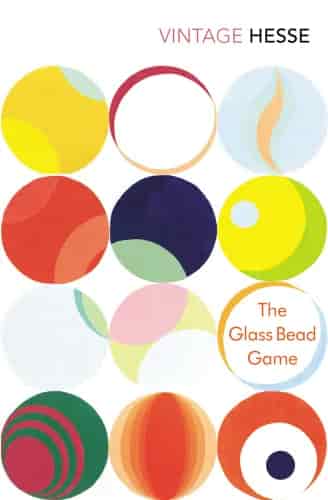
At various times the Game was taken up and imitated by nearly all the scientific and scholarly disciplines… — Hermann Hesse
At various times the Game was taken up and imitated by nearly all the scientific and scholarly disciplines, that is, adapted to the special fields. There is documented evidence for its application to the fields of classical philology and logic. The analytical study of musical values had led to the reduction of musical events to physical and mathematical formulas. Soon afterward philology borrowed this method and began to measure linguistic configurations as physics measures processes in nature. The visual arts soon followed suit, architecture having already led the way in establishing the links between visual art and mathematics. Thereafter more and more new relations, analogies, and correspondences were discovered among the abstract formulas obtained in this way. Each discipline which seized upon the Game created its own language of formulas, abbreviations, and possible combinations. Everywhere, the elite intellectual youth developed a passion for these Games, with their dialogues and progressions of formulas. The Game was not mere practice and mere recreation; it became a form of concentrated self-awareness for intellectuals. Mathematicians in particular played it with a virtuosity and formal strictness at once athletic and ascetic. It afforded them a pleasure which somewhat compensated for their renunciation of worldly pleasures and ambitions. For by then such renunciation had already become a regular thing for intellectuals. The Glass Bead Game contributed largely to the complete default of feuilletonism and to that newly awakened delight in strict mental exercises to which we owe the origin of a new, monastically austere intellectual discipline.
Source: Wikiquote · CC BY-SA 4.0
More from this book
In prehistoric times, music, like dance and every other artistic endeavor, was a branch of magic, one of the old and legitimate instruments of wonder-working. Beginning with rhythm (clapping of hands, tramping, beating of sticks and primitive drums) it was a powerful, tried-and-true device for putting large number of people “in tune” with one another, engendering the same mood, co-coordinating the pace of their breathing and heartbeats, encouraging them to invoke and conjure up the eternal powers, to dance, to compete, to make war, to worship. And music has retained this original, pure, primordially powerful character, its magic, far longer than the other arts.
There are many types and kinds of vocation, but the core of the experience is always the same: the soul is awakened by it, transformed or exalted, so that instead of dreams and presentiments from within a summons comes from without.
The Glass Bead Game, formerly the specialized entertainment of mathematicians in one era, philologists or musicians in another era, now more and more cast its spell upon all true intellectuals. ... After Joculator Basiliensis' grand accomplishment, the Game rapidly evolved into what it is today: the quintessence of intellectuality and art, the sublime cult, the unio mystica of all separate members of the Universitas Litterarum. In our lives it has partially taken over the role of art, partially that of speculative philosophy.