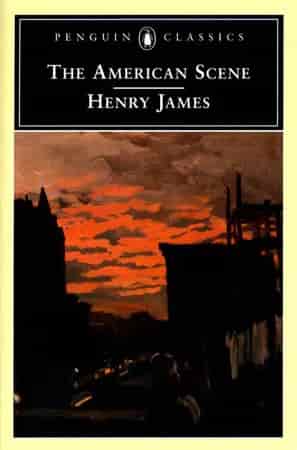
The social scene, shabby and sordid, and lost in the scale of space as the quotable line is lost in a dull… — Henry James
The social scene, shabby and sordid, and lost in the scale of space as the quotable line is lost in a dull epic or the needed name in an ageing memory, would have been as interesting, probably, as a "short story" in one of the slangy dialects promoted by the illustrated monthly magazines; but it affected me above all, and almost each time, I seem to remember, as speaking of the number of things not cared for. There were some presumably, though not at all discernibly, that were — enough to beget the loose human cohesion, the scant consistency of parts and pieces, to which the array by the railway platform testified; but questions came up, plentifully, in respect to the whole picture, and if the mass of interests that were absent was so remarkably large, this would be certainly because such interests were ruled out. The grimness with which, as by a hard inexorable fate, so many things were ruled out, fixed itself most perhaps as the impression of the spectator enjoying from his supreme seat of ease his extraordinary, his awful modern privilege of this detached yet concentrated stare at the misery of subject populations. (Subject, I mean, to this superiority of his bought convenience — subject even as never, of old, to the sway of satraps or proconsuls.)
p. 397Source: Wikiquote · CC BY-SA 4.0
More from this book
What prevails, what sets the tune, is the American scale of gain, more magnificent than any other, and the fact that the whole assumption, the whole theory of life, is that of the individual's participation in it, that of his being more or less punctually and more or less effectually "squared." To make so much money that you won't, that you don't "mind," don't mind anything — that is absolutely, I think, the main American formula.
p. 237
It is of the nature of many American impressions, accepted at the time as a whole of the particular story, simply to cease to be, as soon as your back is turned — to fade, to pass away, to leave not a wreck behind. This happens not least when the image, whatever it may have been, has exacted the tribute of wonder or pleasure: it has displayed every virtue but the virtue of being able to remain with you. Its pressure and power have failed of some weight, some element of density or intensity, some property or quality in short that makes for the authority of a figure, for the complexity of a scene.
p. 454
He is confronted too often, to his sense, with the question of what may be "borne"; but what does he see about him if not a vast social order in which the parties to certain relations are all the while marvellously, inscrutably, desperately "bearing" each other? He may wonder, at his hours, how, under the strain, social cohesion does not altogether give way; but that is another question, which belongs to a different plane of speculation. For he asks himself quite as much as anything else how the shopman or the shoplady can bear to be barked at in the manner he constantly hears used to them by customers — he recognizes that no agreeable form of intercourse could survive a day in such air: so that what is the only relation finding ground there but a necessary vicious circle of gross mutual endurance?
p. 236