George Orwell
Quotes
On each landing, opposite the lift-shaft, the poster with the enormous face gazed from the wall. It was one of those pictures which are so contrived that the eyes follow you about when you move. BIG BROTHER IS WATCHING YOU' the caption beneath it ran.
There were the vast repositories where the corrected documents were stored, and the hidden furnaces where the original copies were destroyed. And somewhere or other, quite anonymous, there were the directing brains who coordinated the whole effort and laid down the lines of policy which made it necessary that this fragment of the past should be preserved, that one falsified, and the other rubbed out of existence.
At the age of three Comrade Ogilvy had refused all toys except a drum, a sub-machine gun, and a model helicopter. At six — a year early, by a special relaxation of the rules — he had joined the Spies, at nine he had been a troop leader. At eleven he had denounced his uncle to the Thought Police after overhearing a conversation which appeared to him to have criminal tendencies. At seventeen he had been a district organizer of the Junior Anti-Sex League. At nineteen he had designed a hand-grenade which had been adopted by the Ministry of Peace and which, at its first trial, had killed thirty-one Eurasian prisoners in one burst. At twenty-three he had perished in action. Pursued by enemy jet planes while flying over the Indian Ocean with important dispatches, he had weighted his body with his machine gun and leapt out of the helicopter into deep water, dispatches and all — an end, said Big Brother, which it was impossible to contemplate without feelings of envy.
Like an answer, the three slogans on the white face of the Ministry of Truth came back to him: WAR IS PEACE, FREEDOM IS SLAVERY, IGNORANCE IS STRENGTH. On coins, on stamps, on the covers of books, on banners, on posters, and on the wrappings of a cigarette Packet — everywhere. Always the eyes watching you and the voice enveloping you. Asleep or awake, working or eating, indoors or out of doors, in the bath or in bed — no escape. Nothing was your own except the few cubic centimetres inside your skull.
The horrible thing about the Two Minutes Hate was not that one was obliged to act a part, but that it was impossible to avoid joining in. Within thirty seconds any pretense was always unnecessary. A hideous ecstasy of fear and vindictiveness, a desire to kill, to torture, to smash faces in with a sledge hammer, seemed to flow through the whole group of people like an electric current, turning one even against one's will into a grimacing, screaming lunatic. And yet the rage that one felt was an abstract, undirected emotion which could be switched from one object to another like the flame of a blowlamp.
'The process will still be continuing long after you and I are dead. Every year fewer and fewer words, and the range of consciousness always a little smaller. Even now, of course, there's no reason or excuse for committing thoughtcrime. It's merely a question of self-discipline, reality-control. But in the end there won't be any need even for that. The Revolution will be complete when the language is perfect. Newspeak is Ingsoc and Ingsoc is Newspeak,' he added with a sort of mystical satisfaction. 'Has it ever occurred to you, Winston, that by the year 2050, at the very latest, not a single human being will be alive who could understand such a conversation as we are having now?'
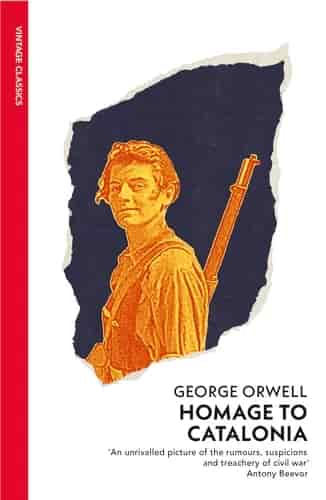
The workers' militias, based on the trade unions and each composed of people of approximately the same political opinions, had the effect of canalizing into one place all the most revolutionary sentiment in the country. I had dropped more or less by chance into the only community of any size in Western Europe where political consciousness and disbelief in capitalism were more normal than their opposites.
It is the same in all wars; the soldiers do the fighting, the journalists do the shouting, and no true patriot ever gets near a front-line trench, except on the briefest of propaganda-tours. Sometimes it is a comfort to me to think that the aeroplane is altering the conditions of war. Perhaps when the next great war comes we may see that sight unprecedented in all history, a jingo with a bullet-hole in him.
It was queer how the general spirit seemed to change when you got anywhere near the front line. All or nearly all of the vicious hatred of the political parties evaporated.
I have no particular love for the idealised "worker" as he appears in the bourgeois Communist's mind, but when I see an actual flesh-and-blood worker in conflict with his natural enemy, the policeman, I do not have to ask myself which side I am on.
In reality it was the Communists above all others who prevented revolution in Spain.
One of the most horrible features of war is that all the war-propaganda, all the screaming and lies and hatred, comes invariably from people who are not fighting.