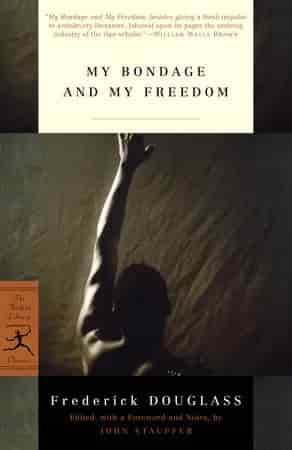
Frederick Douglass
Quotes
You have seen how a man was made a slave; you shall see how a slave was made a man.
On this inauguration day, while waiting for the opening of the ceremonies, I made a discovery in regard to the vice president — Andrew Johnson. There are moments in the lives of most men, when the doors of their souls are open, and unconsciously to themselves, their true characters may be read by the observant eye. It was at such an instant I caught a glimpse of the real nature of this man, which all subsequent developments proved true. I was standing in the crowd by the side of Mrs. Thomas J. Dorsey, when Mr. Lincoln touched Mr. Johnson, and pointed me out to him. The first expression which came to his face, and which I think was the true index of his heart, was one of bitter contempt and aversion. Seeing that I observed him, he tried to assume a more friendly appearance; but it was too late; it was useless to close the door when all within had been seen. His first glance was the frown of the man, the second was the bland and sickly smile of the demagogue. I turned to Mrs. Dorsey and said, 'Whatever Andrew Johnson may be, he certainly is no friend of our race'.
p. 355
I learned, after my mother's death, that she could read, and that she was the only one of all the slaves and colored people in Tuckahoe who enjoyed that advantage. How she acquired this knowledge, I know not, for Tuckahoe is the last place in the world where she would be apt to find facilities for learning. I can, therefore, fondly and proudly ascribe to her an earnest love of knowledge. That a "field hand" should learn to read, in any slave state, is remarkable; but the achievement of my mother, considering the place, was very extraordinary; and, in view of that fact, I am quite willing, and even happy, to attribute any love of letters I possess, and for which I have got—despite of prejudices—only too much credit, not to my admitted Anglo-Saxon paternity, but to the native genius of my sable, unprotected, and uncultivated mother—a woman, who belonged to a race whose mental endowments it is, at present, fashionable to hold in disparagement and contempt.
I had been living four or five months in New Bedford when there came a young man to me with a copy of w:The Liberator, the paper edited by William Lloyd Garrison and published by Isaac Knapp, and asked me to subscribe for it. I told him I had but just escaped from slavery, and was of course very poor, and had no money then to pay for it. He was very willing to take me as a subscriber, notwithstanding, and from this time I was brought into contact with the mind of Mr. Garrison, and his paper took a place in my heart second only to the Bible. It detested slavery, and made no truce with the traffickers in the bodies and souls of men. It preached human brotherhood; it exposed hypocrisy and wickedness in high places; it denounced oppression; and with all the solemnity of "Thus saith the Lord," demanded the complete emancipation of my race. I loved this paper and its editor. He seemed to me an all-sufficient match to every opponent, whether they spoke in the name of the law or the gospel. His words were full of holy fire, and straight to the point. Something of a hero-worshiper by nature, here was one to excite my admiration and reverence. It was my privilege to listen to a lecture in Liberty Hall by Mr. Garrison, its editor. He was then a young man, of a singularly pleasing countenance, and earnest and impressive manner. On this occasion he announced nearly all his heresies. His Bible was his textbook — held sacred as the very word of the Eternal Father. He believed in sinless perfection, complete submission to insults and injuries, and literal obedience to the injunction if smitten "on one cheek to turn the other also." Not only was Sunday a Sabbath, but all days were Sabbaths, and to be kept holy. All sectarianism was false and mischievous — the regenerated throughout the world being members of one body, and the head Christ Jesus. Prejudice against color was rebellion against God. Of all men beneath the sky, the slaves, because most neglected and despised, were nearest and dearest to his great heart. Those ministers who defended slavery from the Bible were of their "father the devil"; and those churches which fellowshiped slaveholders as Christians, were synagogues of Satan, and our nation was a nation of liars. He was never loud and noisy, but calm and serene as a summer sky, and as pure. "You are the man — the Moses, raised up by God, to deliver his modern Israel from bondage," was the spontaneous feeling of my heart, as I sat away back in the hall and listened to his mighty words, — mighty in truth, — mighty in their simple earnestness.
p. 263
I look upon my departure from Colonel Lloyd's plantation as one of the most interesting events of my life. It is possible, and even quite probable, that but for the mere circumstance of being removed from that plantation to Baltimore, I should have to-day, instead of being here seated by my own table, in the enjoyment of freedom and the happiness of home, writing this Narrative, been confined in the galling chains of slavery. Going to live at Baltimore laid the foundation, and opened the gateway, to all my subsequent prosperity. I have ever regarded it as the first plain manifestation of that kind providence which has ever since attended me, and marked my life with so many favors. I regarded the selection of myself as being somewhat remarkable. There were a number of slave children that might have been sent from the plantation to Baltimore. There were those younger, those older, and those of the same age. I was chosen from among them all, and was the first, last, and only choice.
I may be deemed superstitious, and even egotistical, in regarding this event as a special interposition of divine Providence in my favor. But I should be false to the earliest sentiments of my soul, if I suppressed the opinion. I prefer to be true to myself, even at the hazard of incurring the ridicule of others, rather than to be false, and incur my own abhorrence. From my earliest recollection, I date the entertainment of a deep conviction that slavery would not always be able to hold me within its foul embrace; and in the darkest hours of my career in slavery, this living word of faith and spirit of hope departed not from me, but remained like ministering angels to cheer me through the gloom. This good spirit was from God, and to him I offer thanksgiving and praise.
My long-crushed spirit rose, cowardice departed, bold defiance took its place; and I now resolved that, however long I might remain a slave in form, the day had passed forever when I could be a slave in fact. I did not hesitate to let it be known of me, that the white man who expected to succeed in whipping, must also succeed in killing me.
To make a contented slave it is necessary to make a thoughtless one. It is necessary to darken the moral and mental vision and, as far as possible, to annihilate the power of reason.
I love the pure, peaceable, and impartial Christianity of Christ; I therefore hate the corrupt, slave-holding, women-whipping, cradle-plundering, partial and hypocritical Christianity of this land.
Mr. Lincoln was not only a great President, but a great man — too great to be small in anything. In his company I was never in any way reminded of my humble origin, or of my unpopular color.
It was when General Grant was fighting his way through the Wilderness to Richmond, on the 'line' he meant to pursue 'if it took all summer', and every reverse to his arms was made the occasion for a fresh demand for peace without emancipation, that President Lincoln did me the honor to invite me to the Executive Mansion for a conference on the situation. I need not say I went most gladly. The main subject on which he wished to confer with me was as to the means most desirable to be employed outside the army to induce the slaves in the rebel States to come within the Federal lines. The increasing opposition to the war, in the North, and the mad cry against it, because it was being made an abolition war, alarmed Mr. Lincoln, and made him apprehensive that a peace might be forced upon him which would leave still in slavery all who had not come within our lines.
p. 434
I say nothing of father, for he is shrouded in a mystery I have never been able to penetrate. Slavery does away with fathers, as it does away with families. Slavery has no use for either fathers or families, and its laws do not recognize their existence in the social arrangements of the plantation.
We have men sold to build churches, women sold to support the gospel, and babes sold to purchase Bibles for the poor heathen! all for the glory of God and the good of souls! The slave auctioneer's bell and the church-going bell chime in with each other, and the bitter cries of the heart-broken slave are drowned in the religious shouts of his pious master. Revivals of religion and revivals in the slave-trade go hand in hand.