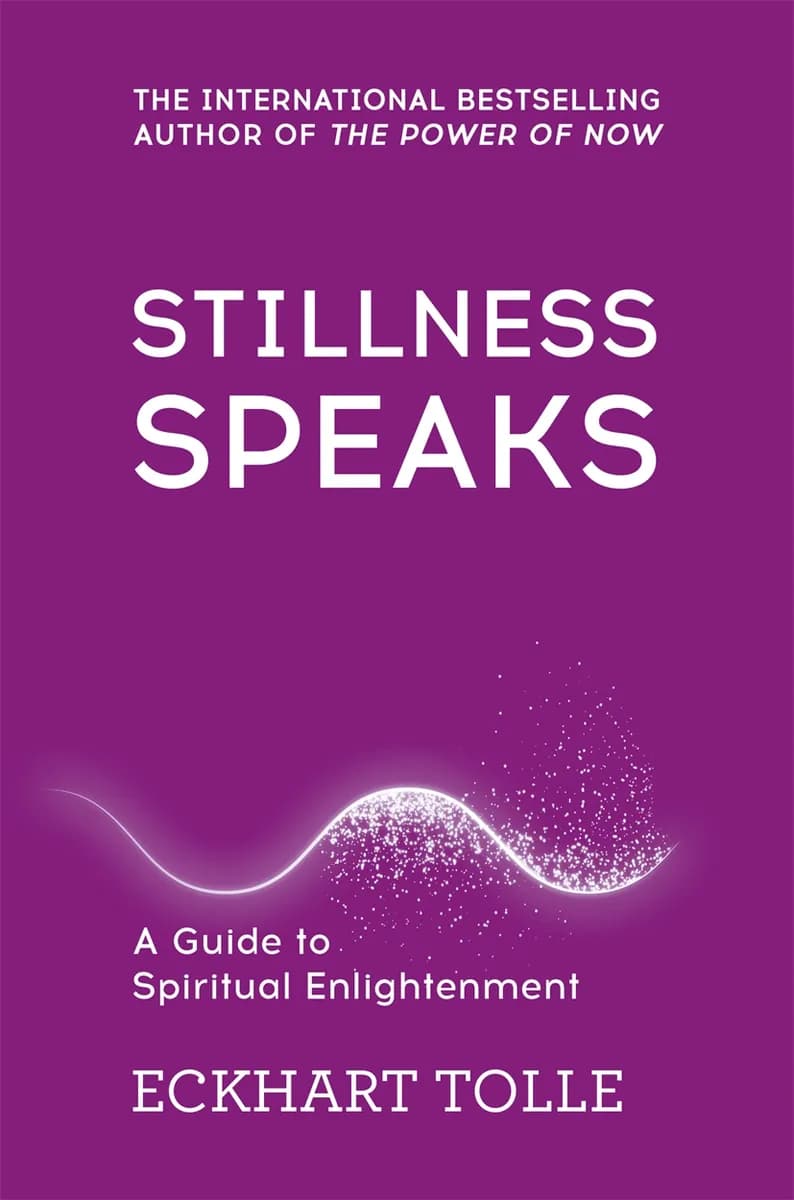
Eckhart Tolle
Quotes
Finding that dimension frees you and the world from the suffering you inflict on yourself and others when the mind-made “little me” is all you know and runs your life. Love, joy, creative expansion, and lasting inner peace cannot come into your life except through that unconditioned dimension of consciousness. (Ch 2)
Just as the ancient sutras, the writings contained within this book are sacred and have come out of a state of consciousness we may call stillness. Unlike those ancient sutras, however, they don’t belong to any one religion or spiritual tradition, but are immediately accessible to the whole of humanity. There is also an added sense of urgency here. The transformation of human consciousness is no longer a luxury, so to speak, available only to a few isolated individuals, but a necessity if humankind is not to destroy itself. (intro)
Do you need more knowledge? Is more information going to save the world, or faster computers, more scientific or intellectual analysis? Is it not wisdom that humanity needs most at this time? But what is wisdom and where is it to be found? Wisdom comes with the ability to be still. Just look and just listen. No more is needed. Being still, looking, and listening activates the non-conceptual intelligence within you. Let stillness direct your words and actions. (Ch 1)
The human condition: Lost in thought Most people spend their entire life imprisoned within the confines of their own thoughts. They never go beyond a narrow, mind-made, personalized sense of self that is conditioned by the past. In you, as in each human being, there is a dimension of consciousness far deeper than thought. It is the very essence of who you are. We may call it presence, awareness, the unconditioned consciousness. In the ancient teachings, it is the Christ within, or your Buddha nature.
You are that awareness, disguised as a person. (Ch 1)
A true spiritual teacher does not have anything to teach in the conventional sense of the word, does not have anything to give or add to you, such as new information, beliefs, or rules of conduct. The only function of such a teacher is to help you remove that which separates you from the truth of who you already are and what you already know in the depth of your being.
A moment of danger can bring about a temporary cessation of the stream of thinking and thus give you a taste of what it means to be present, alert, aware. (Ch 2)
Stillness is your essential nature. What is stillness? The inner space or awareness in which the words on this page are being perceived and become thoughts. Without that awareness, there would be no perception, no thoughts, no world. (Ch 1)
If you come to a spiritual teacher — or this book — looking for stimulating ideas, theories, beliefs, intellectual discussions, then you will be disappointed. This is not a book to be read from cover to cover and then put away. Live with it, pick it up frequently, and more importantly, put it down frequently, or spend more time holding it than reading it. Many readers will feel naturally inclined to stop reading after each entry, to pause, reflect, become still. It is always more helpful and more important to stop reading than to continue reading. Allow the book to do its work, to awaken you from the old grooves of your repetitive and conditioned thinking. (intro)
There is an aliveness in you that you can feel with your Being, not just in the head. Every cell is alive in that presence in which you don't need to think. Yet, in that state, if thought is required for some practical purpose, it is there. The mind can still operate, and it operated beautifully when the greater intelligence that you are uses it and expresses itself through it. (Ch 2)
When you lose touch with inner stillness, you lose touch with yourself. When you lose touch with yourself, you lose yourself in the world. Your innermost sense of self, of who you are, is inseparable from stillness. This is the “I Am” that is deeper than name and form.
The form of this book can be seen as a revival for the present age of the oldest form of recorded spiritual teachings: the sutras of ancient India. Sutras are powerful pointers to the truth in the form of aphorisms or short sayings, with little conceptual elaboration. The Vedas and Upanishads are the early sacred teachings recorded in the form of sutras, as are the words of the Buddha. The sayings and parables of Jesus, too, when taken out of their narrative context, could be regarded as sutras, as well as the profound teachings contained in the Tao Te Ching, the ancient Chinese book of wisdom. The advantage of the sutra form lies in its brevity... (intro)