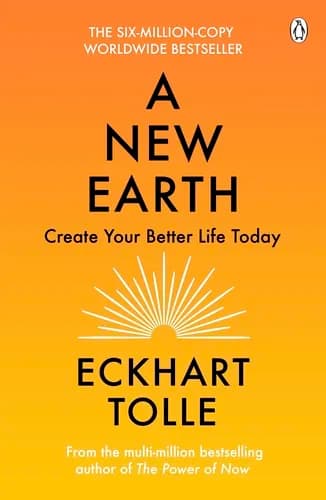
Eckhart Tolle
Quotes
This illusory sense of self is what Albert Einstein, who had deep insights not only in to the reality of space and time but also into human nature, referred to as “an optical illusion of consciousness.”
Whatever the ego seeks and gets attached to are substitutes for the Being that it cannot feel. You can value and care for things, but whenever you get attached to them, you will know it’s the ego.
When told that there is a voice in their head that never stops speaking, they say, “What voice?” or angrily deny it, which of course is the voice, is the thinker, is the unobserved mind. It could almost be looked upon as an entity that has taken possession of them.
Underneath the surface appearance, everything is not only connected with everything else, but also with the Source of all life out of which it came. Underneath the surface appearance, everything is not only connected with everything else, but also with the Source of all life out of which it came. Even a stone, and more easily a flower or a bird, could show you the way back to God, to the Source, to yourself. When you look at it or hold it and let it be without imposing a word or mental label on it, a sense of awe, of wonder, arises within you. Its essence silently communicates itself to you and reflects your own essence back to you. This is what great artists sense and succeed in conveying in their art. Van Gogh didn’t say: “That’s just an old chair.” He looked, and looked, and looked. He sensed the Beingness of the chair. Then he sat in front of the canvas and took up the brush.
The ego tends to equate having with Being: I have, therefore I am. And the more I have, the more I am. The ego lives through comparison.
Some economists are so attached to the notion of growth that they can’t let go of that word, so they refer to recession as a time of “negative growth.”
All we can perceive, experience, think about, is the surface layer of reality, less than the tip of an iceberg.
No ego can last for long without the need for more. Therefore, wanting keeps the ego alive much more than having. The ego wants to want more than it wants to have.
Of course, in this physical dimension that our surface selves inhabit, things are a necessary and inescapable part of our lives. We need housing, clothes, furniture, tools, transportation. There may also be things in our lives that we value because of their beauty or inherent quality.
The collective manifestations of the insanity that lies at the heart of the human condition constitute the greater part of human history. It is to a large extent a history of madness.
The ego isn’t wrong; it’s just unconscious. When you observe the ego in yourself, you are beginning to go beyond it. Don’t take the ego too seriously. When you detect egoic behavior in yourself, smile... It isn’t who you are.
Driven by greed, ignorant of their connectedness to the whole, humans persist in behavior that, if continued unchecked, can only result in their own destruction.