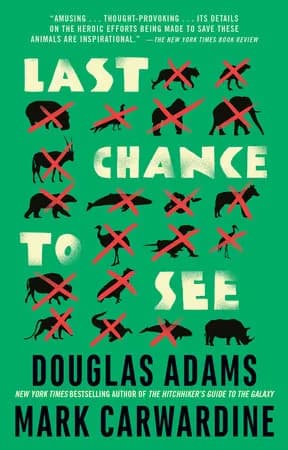
Douglas Adams
Quotes
It was instantly clear what he was doing. He was contemplating life. He was hanging out. It was quite obvious. Or rather, the temptation to find it quite obvious was absolutely overwhelming.
They look like humans, they move like humans, they hold things in their fingers like humans, the expressions which play across their faces and in their intensely human-looking eyes are expressions that we instinctively feel we recognise as human expressions. We look them in the face and we think, “We know what they’re like,” but we don’t. Or rather, we actually block off any possible glimmering of understanding of what they may be like by making easy and tempting assumptions.
p. 79
Like most colonies, Zaïre had impose on it a stifling bureaucracy, the sole function of which was to refer decisions upward to its colonial masters. Local officials rarely had the power to do things, only to prevent them from being done until bribed. So once the colonial masters are removed, the bureaucracy continues to thrash around like a headless chicken with nothing to do but trip itself up, bump into things, and, when it can get the firepower, shoot itself in the foot. You can always tell an ex-colony from the inordinate numbers of people who are able to find employment stopping anybody who has anything to do from doing it.
p. 65
I believe in traveling light, but then I also believe that I should give up smoking and shop early for Christmas.
p. 67
But while nature has considerable resilience, there is a limit to how far that resilience can be stretched. No one knows how close to the limit we are getting. The darker it gets, the faster we’re driving.
p. 213
As if things aren’t difficult enough already, the female [kakapo] can only come into breeding condition when a particular plant, the podocarp for instance, is bearing fruit. This only happens every two years. Until it does, the male can boom all he likes, it won’t do him any good. The kakapo’s persnickety dietary requirements are a whole other area of exasperating difficulty. It makes me tired just to think of them, so I think we’ll pass quickly over all that. Imagine being an airline steward trying to serve meals to a plane full of Moslems, Jews, vegetarians, vegans, and diabetics when all you’ve got is turkey because it’s Christmastime, and that will give you the idea.
The males, therefore, get extremely overwrought sitting in their bowls making noises for months on end, waiting for their mates, who are waiting for a particular type of tree to fruit. When one of the rangers who was working in an area where kakapos were booming happened to leave his hat on the ground, he came back later to find a kakapo attempting to ravish it. On another occasion the discovery of some ruffled possum fur in the mating area suggested that a kakapo had made another alarming mistake, an experience which is unlikely to have been satisfying to either party.
p. 118
I’ve heard an idea proposed, I’ve no idea how seriously, to account for the sensation of vertigo. It’s an idea that I instinctively like and it goes like this.
The dizzy sensation we experience when standing in high places is not simply a fear of falling. It’s often the case that the only thing likely to make us fall is the actual dizziness itself, so it is, at best, an extremely irrational, even self-fulfilling fear. However, in the distant past of our evolutionary journey toward our current state, we lived in trees. We leapt from tree to tree. There are even those who speculate that we may have something birdlike in our ancestral line. In which case, there may be some part of our mind that, when confronted with a void, expects to be able to leap out into it and even urges us to do so. So what you end up with is a conflict between a primitive, atavistic part of your mind which is saying “Jump!” and the more modern, rational part of your mind which is saying, “For Christ’s sake, don’t!”
p. 74
Most of the other shops were in fact impossible to identify. When a shop appeared to sell a mixture of ghetto blasters, socks, soap, and chickens, it didn’t seem unreasonable to go in and ask if they had any or toothpaste or paper stuck away on one of their shelves as well, but they looked at me as if I was completely mad. Couldn’t I see that this was a ghetto blaster, socks, soap, and chicken shop?
p. 61
I didn’t notice that I was being set upon by a pickpocket, which I am glad of, because I like to work only with professionals.
p. 64
When the thudding blades of the helicopter are finally still, the spacious murmur of the valley gradually rises to fill the silence: the low thunder of cataracts, the distant hiss of the sea, the rustling of the breeze in the scrubby grass, the keas explaining who they are to one another. There is one sound, however, that we know we are not going to hear—not just because we have arrived at the wrong time of day, but because we have arrived in the wrong year. There will not be any more right years.
p. 110
In the middle of one of the biggest, longest, noisiest, dirtiest thoroughfares in the world lives the reincarnation of a drowned princess, or rather, two hundred reincarnations of a drowned princess.
Whether these are two hundred different reincarnations of the same drowned princess, or the individual reincarnations of two hundred different drowned princesses, is something that the legends are a little vague about, and there are no reliable statistics on the incidence of princess-drownings in the area available to help clear the matter up.
If they are all the same drowned princess, then she must have lived a life of exquisite sinfulness to have had the conditions of her current lives repeatedly inflicted on her. Her reincarnations are constantly being mangled in ships’ propellers, snared in fishermen’s nets full of hooks, blinded, poisoned, and deafened.
The thoroughfare in question is the Yangtze river, and the reincarnated princess is the Baiji, the Yangtze river dolphin.
p. 145
One of the first things you need to know about Richard Lewis, indeed the thing you need to know about him, is that he’s an ornithologist. Once you know that, everything else more or less falls into place.
p. 180
Gorillas are not yet sufficiently advanced in evolutionary terms to have discovered the benefits of passports, currency-declaration forms, and official bribery, and therefore tend to wander backward and forward across the border as and when their beastly, primitive whim takes them.
p. 63