Dave Barry
Quotes
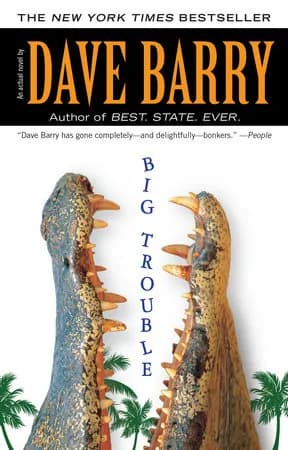
After the door closed behind them, there was a moment of silence in the Jolly Jackal. Finally, John, sitting on the floor next to the briefcase containing ten thousand dollars in cash, said to Leo, Kakimi chertyami oni viigrali holodnuyu voinu? This translates roughly to: "How the hell did these people win the Cold War?" (Chapter 6)
Gamblers need action, even when the odds suck. And so they return to the ships, night after night—the slot-machine ladies, clutching their plastic cups of quarters; the shouting, hard-drinking craps-table crowd; the roulette addicts, who truly believe, all evidence to the contrary, that there is something lucky about their birthdates; the blackjack loners, with their foolproof systems that don't work—all of them eager to resume the inexorable process of transferring their cash to whoever owns the ship. In the case of the Extravaganza of the Seas, the owner of record was a man named Bobby Kemp, who was usually described in the newspaper as a millionaire entrepreneur. Kemp liked the look of that, entrepreneur, although he personally could not pronounce it. (Chapter 2)
What was life like in the colonies? Probably the best word to describe it would be "colonial".
I think that parents- not all of them, but a lot of them- are sucking the fun out of kids' sports. They're making it clear to their kids that they think sports is about winning, and only winning. This is a reasonable value to instill if you honestly believe your child is going to become a professional athlete. But you need to remember two things: 1. Your child is not, in fact, going to become a professional athlete. 2. There are more important things in life than winning. Such as not being a jerk.
p. 244
In sports, Vijay Singh wins the Masters golf tournament and is awarded the coveted green jacket, which is quickly snatched away by angry Buick executives and given to Tiger Woods.
If Man A asks Man B for directions, Man B, realizing that Man A is a weak, direction-asking type of male who probably also reads owner's manuals, could decide to attack Man A's village and plunder his women. Man A is not about to run that type of risk.
p. 27
Two invasive species in particular have caused serious concern: Burmese pythons, and New Yorkers. The New Yorkers have been coming for years, which is weird because pretty much all they do once they get to Florida is bitch about how everything here sucks compared to the earthly paradise that is New York. They continue to root, loudly, for the Jets, the Knicks, the Mets, and the Yankees; they never stop declaring, loudly, that in New York the restaurants are better, the stores are nicer, the people are smarter, the public transportation is free of sharks, etc. The Burmese pythons are less obnoxious, but just as alarming in their own way. These are snakes that started out as pets of Miami residents, until one day these residents stopped smoking crack and said, "Jesus H. Christ! We're living with a giant snake!"
p. 84
• Roughly eight of these people understand the purpose of the turn signal.
p. 43
The American newspaper industry is in serious trouble. How serious? Consider: In 1971, when I was hired for my first newspaper job, there were 62 million newspaper subscribers in the United States; today, there are twelve, an estimated five of whom are dead and therefore unlikely to renew.
p. 185
This book is dedicated to everybody who buys this book. Without you, I would have to get an actual job.
Sharks are hardy creatures, but they do not thrive on public transportation.
p. 83
There were automobiles, but they lacked many of the features that automobiles have today, such as a working motor. In the Barry household, we had a series of cars named (these were all real Barry cars) the "Rambler," the "Minx," the "Metropolitan," and the "Valiant." You could rely on these cars- rain or shine, hot or cold- to not start. The "Metropolitan," in particular, was no more capable of internal combustion than of producing a litter of puppies.
p. 54