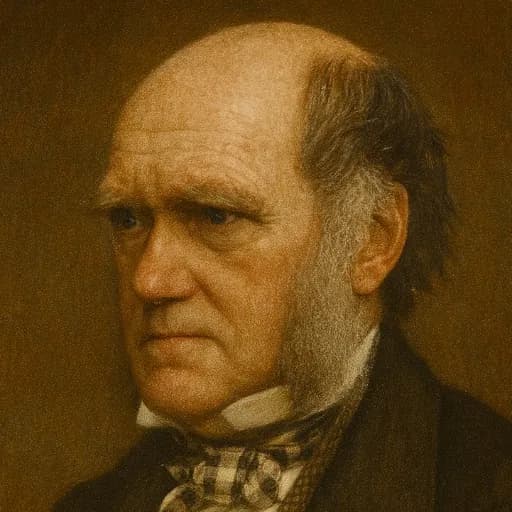
Charles Darwin
Quotes
The expression often used by Mr. Herbert Spencer of the Survival of the Fittest is more accurate, and is sometimes equally convenient.
p. 72
[I]s it possible that an animal having, for instance, the structure and habits of a bat, could have been formed by the modification of some animal with wholly different habits? Can we believe that natural selection could produce, on the one hand, organs of trifling importance, such as the tail of a giraffe, which serves as a fly-flapper, and, on the other hand, organs of such wonderful structure, as the eye, of which we hardly as yet fully understand the inimitable perfection?
p. 171
Long before having arrived at this part of my work, a crowd of difficulties will have occurred to the reader. Some of them are so grave that to this day I can never reflect on them without being staggered; but, to the best of my judgment, the greater number are only apparent, and those that are real are not, I think, fatal to my theory.
p. 171
A fancier is struck by a pigeon having a slightly shorter beak; another fancier is struck by a pigeon having a rather longer beak; and on the acknowledged principle that "fanciers do not and will not admire a medium standard, but like extremes," they both go on (as has actually occurred with tumbler-pigeons) choosing and breeding from birds with longer and longer beaks, or with shorter and shorter beaks. Again, we may suppose that at an early period one man preferred swifter horses; another stronger and more bulky horses. The early differences would be very slight; in the course of time, from the continued selection of swifter horses by some breeders, and of stronger ones by others, the differences would become greater, and would be noted as forming two sub-breeds; finally, after the lapse of centuries, the sub-breeds would become converted into two well-established and distinct breeds. As the differences slowly become greater, the inferior animals with intermediate characters, being neither very swift nor very strong, will have been neglected, and will have tended to disappear. Here, then, we see in man's productions the action of what may be called the principle of divergence, causing differences, at first barely appreciable, steadily to increase, and the breeds to diverge in character both from each other and from their common parent.But how, it may be asked, can any analogous principle apply in nature? I believe it can and does apply most efficiently, from the simple circumstance that the more diversified the descendants from any one species become in structure, constitution, and habits, by so much will they be better enabled to seize on many and widely diversified places in the polity of nature, and so be enabled to increase in numbers.
p. 112
That our palæontological collections are very imperfect, is admitted by every one. The remark of that admirable palæontologist, the late Edward Forbes, should not be forgotten, namely, that numbers of our fossil species are known and named from single and often broken specimens, or from a few specimens collected on some one spot. Only a small portion of the surface of the earth has been geologically explored, and no part with sufficient care, as the important discoveries made every year in Europe prove.
p. 287
We behold the face of nature bright with gladness, we often see superabundance of food; we do not see, or we forget, that the birds which are idly singing round us mostly live on insects or seeds, and are thus constantly destroying life; or we forget how largely these songsters, or their eggs, or their nestlings, are destroyed by birds and beasts of prey; we do not always bear in mind, that though food may be now superabundant, it is not so at all seasons of each recurring year.
p. 62
When we look to the individuals of the same variety or sub-variety of our older cultivated plants and animals, one of the first points which strikes us, is, that they generally differ much more from each other, than do the individuals of any one species or variety in a state of nature. When we reflect on the vast diversity of the plants and animals which have been cultivated, and which have varied during all ages under the most different climates and treatment, I think we are driven to conclude that this greater variability is simply due to our domestic productions having been raised under conditions of life not so uniform as, and somewhat different from, those to which the parent-species have been exposed under nature.
p. 7
Descent with modification.
p. 171
I should premise that I use the term Struggle for Existence in a large and metaphorical sense, including dependence of one being on another, and including (which is more important) not only the life of the individual, but success in leaving progeny.
p. 62
I must premise, that I have nothing to do with the origin of the primary mental powers, any more than I have with that of life itself. We are concerned only with the diversities of instinct and of the other mental qualities of animals within the same class.
p. 207
If it could be demonstrated that any complex organ existed, which could not possibly have been formed by numerous, successive, slight modifications, my theory would absolutely break down. But I can find out no such case.
p. 189
[I]t is highly important for us to gain some notion, however imperfect, of the lapse of years. During each of these years, over the whole world, the land and the water has been peopled by hosts of living forms. What an infinite number of generations, which the mind cannot grasp, must have succeeded each other in the long roll of years! Now turn to our richest geological museums, and what a paltry display we behold!
p. 287