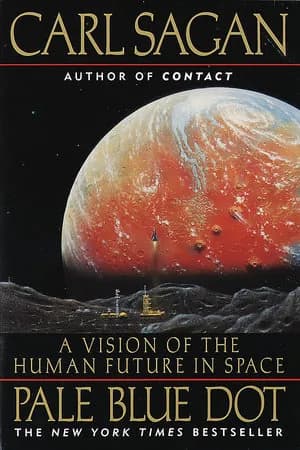
Carl Sagan
Quotes
A scientific colleague tells me about a recent trip to the New Guinea highlands where she visited a stone age culture hardly contacted by Western civilization. They were ignorant of wristwatches, soft drinks, and frozen food. But they knew about Apollo 11. They knew that humans had walked on the Moon. They knew the names of Armstrong and Aldrin and Collins. They wanted to know who was visiting the Moon these days.
p. 281
Since, in the long run, every planetary society will be endangered by impacts from space, every surviving civilization is obliged to become spacefaring — not because of exploratory or romantic zeal, but for the most practical reason imaginable: staying alive.
p. 371
You see, the religious people — most of them — really think this planet is an experiment. That's what their beliefs come down to. Some god or other is always fixing and poking, messing around with tradesmen's wives, giving tablets on mountains, commanding you to mutilate your children, telling people what words they can say and what words they can't say, making people feel guilty about enjoying themselves, and like that. Why can't the gods leave well enough alone? All this intervention speaks of incompetence. If God didn't want Lot's wife to look back, why didn't he make her obedient, so she'd do what her husband told her? Or if he hadn't made Lot such a shithead, maybe she would've listened to him more. If God is omnipotent and omniscient, why didn't he start the universe out in the first place so it would come out the way he wants? Why's he constantly repairing and complaining? No, there's one thing the Bible makes clear: The biblical God is a sloppy manufacturer. He's not good at design, he's not good at execution. He'd be out of business if there was any competition.
p. 285
Jingoistic rhetoric and puerile self-congratulatory nationalism.
p. 181
A celibate clergy is an especially good idea, because it tends to suppress any hereditary propensity toward fanaticism.
p. 244
Once we overcome our fear of being tiny, we find ourselves on the threshold of a vast and awesome Universe that utterly dwarfs — in time, in space, and in potential — the tidy anthropocentric proscenium of our ancestors. We gaze across billions of light-years of space to view the Universe shortly after the Big Bang, and plumb the fine structure of matter. We peer down into the core of our planet, and the blazing interior of our star. We read the genetic language in which is written the diverse skills and propensities of every being on Earth. We uncover hidden chapters in the record of our origins, and with some anguish better understand our nature and prospects. We invent and refine agriculture, without which almost all of us would starve to death. We create medicines and vaccines that save the lives of billions. We communicate at the speed of light, and whip around the Earth in an hour and a half. We have sent dozens of ships to more than seventy worlds, and four spacecraft to the stars. We are right to rejoice in our accomplishments, to be proud that our species has been able to see so far, and to judge our merit in part by the very science that has so deflated our pretensions.
p. 53
She too had found the experience transforming. How could she not? A demon had been exorcised. Several. And just when she felt more capable of love than she had ever been, she found herself alone.
p. 407
It is sometimes said that scientists are unromantic, that their passion to figure out robs the world of beauty and mystery. But is it not stirring to understand how the world actually works — that white light is made of colors, that color is the way we perceive the wavelengths of light, that transparent air reflects light, that in so doing it discriminates among the waves, and that the sky is blue for the same reason that the sunset is red? It does no harm to the romance of the sunset to know a little bit about it.
p. 159
For all its material advantages, the sedentary life has left us edgy, unfulfilled. Even after 400 generations in villages and cities, we haven't forgotten. The open road still softly calls, like a nearly forgotten song of childhood. We invest far-off places with a certain romance. This appeal, I suspect, has been meticulously crafted by natural selection as an essential element in our survival. Long summers, mild winters, rich harvests, plentiful game—none of them lasts forever. It is beyond our powers to predict the future. Catastrophic events have a way of sneaking up on us, of catching us unaware. Your own life, or your band's, or even your species' might be owed to a restless few—drawn, by a craving they can hardly articulate or understand, to undiscovered lands and new worlds.
Herman Melville, in Moby Dick, spoke for wanderers in all epochs and meridians: "I am tormented with an everlasting itch for things remote. I love to sail forbidden seas…"
p. 2
What I'm saying is, if God wanted to send us a message, and ancient writings were the only way he could think of doing it, he could have done a better job.
p. 164
The chiliasts made an atheist out of me.
p. 258
The vast distances that separate the stars are providential. Beings and worlds are quarantined from one another. The quarantine is lifted only for those with sufficient self-knowledge and judgement to have safely traveled from star to star.
p. 398