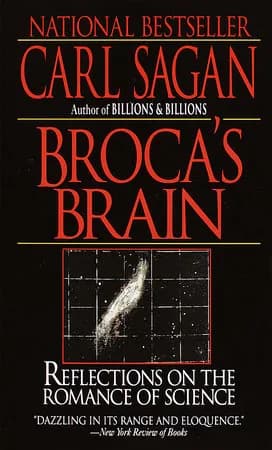
Carl Sagan
Quotes
Where skeptical observation and discussion are suppressed, the truth is hidden. The proponents of such borderline beliefs, when criticized, often point to geniuses of the past who were ridiculed. But the fact that some geniuses were laughed at does not imply that all who are laughed at are geniuses. They laughed at Columbus, they laughed at Fulton, they laughed at the Wright brothers. But they also laughed at Bozo the Clown..
p. 75
It is a good idea not to make up our minds prematurely on this issue. It is probably best not to let our personal preferences influence the decision. Rather, in the long tradition of successful science, we should permit nature to reveal the truth to us.
p. 351
Broca was quoted as saying, “I would rather be a transformed ape than a degenerate son of Adam.”
p. 7
Every new set of discoveries raises a host of questions which we were never before wise enough even to ask.
p. 183
In any case, we do not advance the human cause by refusing to consider ideas that make us frightened.
p. 364
The best antidote for pseudoscience, I firmly believe, is science.
p. 75
But our openness to the dazzling possibilities presented by modern science must be tempered by some hard-nosed skepticism. Many interesting possibilities simply turn out to be wrong. An openness to new possibilities and a willingness to ask hard questions are both required to advance our knowledge. And the asking of tough questions has an ancillary benefit: political and religious life in America, especially in the last decade and a half, has been marked by an excessive public credulity, an unwillingness to ask difficult questions, which has produced a demonstrable impairment in our national health. Consumer skepticism makes quality products. This may be why governments and churches and school systems do not exhibit unseemly zeal in encouraging critical thought. They know they themselves are vulnerable.
p. 68
Both Barnum and H. L. Mencken are said to have made the depressing observation that no one ever lost money by underestimating the intelligence of the American public. The remark has worldwide application. But the lack is not in intelligence, which is in plentiful supply; rather, the scarce commodity is systematic training in critical thinking.
p. 58
I believe that even a smattering of such findings in modern science and mathematics is far more compelling and exciting than most of the doctrines of pseudoscience, whose practitioners were condemned as early as the fifth century B.C. by the Ionian philosopher Heraclitus as “nightwalkers, magicians, priests of Bacchus, priestesses of the wine-vat, mystery-mongers.” But science is more intricate and subtle, reveals a much richer universe, and powerfully evokes our sense of wonder. And it has the additional and important virtue—to whatever extent the word has any meaning—of being true.
p. 76
Vigorous criticism is more constructive in science than in some other areas of human endeavor because in science there are adequate standards of validity that can be agreed upon by competent practitioners the world over. The objective of such criticism is not to suppress but rather to encourage the advance of new ideas: those that survive a firm skeptical scrutiny have a fighting chance of being right, or at least useful.
p. 98
Both borderline science and many religions are motivated in part by a serious concern about the nature of the universe and our role in it, and for this reason merit our consideration and regard. In addition, I think it possible that many religions involve at their cores an attempt to come to grips with profound mysteries of our individual life histories, as described in the last chapter. But both in borderline science and in organized religion there is much that is specious or dangerous. While the practitioners of such doctrines often wish there were no criticisms to which they are expected to reply, skeptical scrutiny is the means, in both science and religion, by which deep insights can be winnowed from deep nonsense.
We are set irrevocably, I believe, on a path that will take us to the stars—unless in some monstrous capitulation to stupidity and greed, we destroy ourselves first.
p. 368