


Carl Hiaasen
Quotes
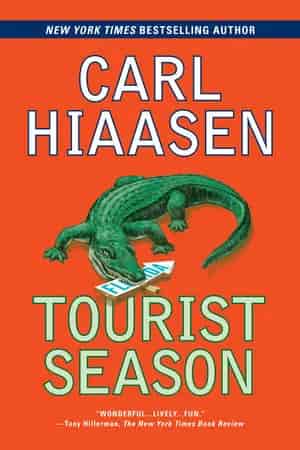
Like many wildly successful Floridians, Francis X. Kingsbury was a transplant. He had moved to the Sunshine State in balding middle age, alone and uprooted, never expecting that he would become a multimillionaire. And like so many new Floridians, Kingsbury was a felon on the run. Before moving to Miami, he was known by his real name of Frankie King. Not Frank, but Frankie. His mother had named him after the singer Frankie Lane. All his life, Frankie King had yearned to change his name to something more distinguished, something with weight and social bearing. A racketeering indictment--seventeen counts--out of Brooklyn was as good an excuse as any. (Chapter 5)
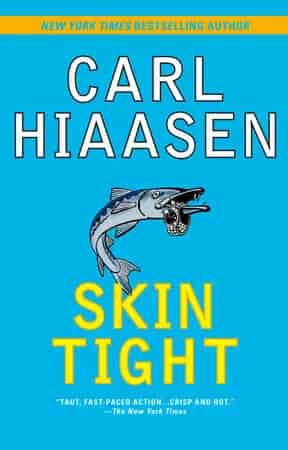
Like everything else at the Amazing Kingdom, the Vole Project had begun as a scheme to compete with Walt Disney World. Years earlier, Disney had tried to save the dusky seaside sparrow, a small marsh bird whose habitat was being wiped out by over-development along Florida's coastline. With much fanfare, Disney had unveiled a captive breeding program for the last two surviving specimens of the dusky. Unfortunately, the last two surviving specimens were both males, and even the wizards of Disney could not induce the scientific miracle of homosexual procreation. Eventually the sparrow fell to extinction, but the Disney organization won gobs of fawning publicity for its conservation efforts. (Chapter 2)
"You can't talk to me like that! You just remember who's the star."
"And you just remember who writes all your lines, and who does all your dull, dull research. Remember who tells you what questions to ask, and who edits these pieces so you don't come off looking like a pompous airhead."
Except that's exactly how Reynaldo came off, most of the time. There was no way around it, no post-production wizardry that could disguise the man's true personality on tape. (Chapter 5)
[Rudy] didn't give two hoots about certification by the American Board of Plastic Surgery, or the American Board of Facial and Reconstructive Surgery, or the American Society of Plastic and Reconstructive Surgeons. What were a couple more snotty plaques on the wall? His patients could care less. They were rich and vain and impatient. In some exclusive South Florida circles, Rudy's name carried the glossy imprimatur of a Gucci or a de la Renta. The lacquered old crones at La Gorce or the Biltmore would point at each other's shiny chins and taut necks and sculpted eyelids and ask, not in a whisper, but in a haughty bray, "is that a Graveline?" Rudy was a designer surgeon. To have him suck your fat was an honor, a social plum, a mark (literally) of status. Only a boor, white trash or worse, would ever question the man's techniques or complain about the results. (Chapter 30)
B.D. Harper had not risen to the pinnacle of his profession by making enemies. His mission, in fact, had been quite the opposite: to make as many friends as possible and offend no one. Harper had been good at this. He positively excreted congeniality. (Chapter 3)
It was then that he had gotten the idea to invite journalists, but not just any journalists: travel writers. Sparky Harper and the Greater Miami Chamber of Commerce adored travel writers because travel writers never wrote stories about street crime, water pollution, fish kills, beach erosion, refugees, AIDS epidemics, nuclear accidents, cocaine smugglers, gun-runners, or race riots. Once in a while, a daring travel writer would mention one of these subjects in passing, but strictly in the context of a minor setback from which South Florida was pluckily rebounding. (Chapter 26)


That’s all the quotes.
6 quotes in the collection · come back when we add more