
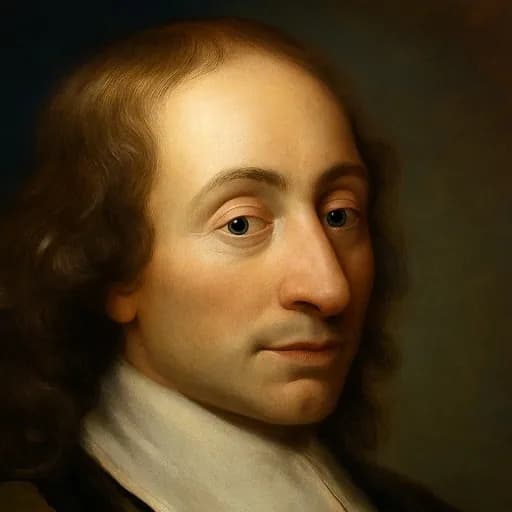
Blaise Pascal
Quotes
The ordinary life of men is like that of the saints. They all seek their satisfaction, and differ only in the object in which they place it... God has then shown the power which He has of giving invisible blessings, by that which He has shown Himself to have over things visible.
The Old Testament contained the types of future joy, and the New contains the means of arriving at it. The types were of joy; the means of penitence; and nevertheless the Paschal Lamb was eaten with bitter herbs, cum amaritudinibus.
Lust has become natural to us, and has made our second nature. Thus there are two natures in us—the one good, the other bad. Where is God? Where you are not, and the kingdom of God is within you.
Sinners lick the dust, that is to say, love earthly pleasures.
Two things instruct man about his whole nature; instinct and experience.
The law was figurative.
All that tends not to charity is figurative. The sole aim of the Scripture is charity.
Le moi est haïssable.
Who is unhappy at having only one mouth? And who is not unhappy at having only one eye? Probably no man ever ventured to mourn at not having three eyes. But any one is inconsolable at having none.
...religion must so be the object and center to which all things tend, that whoever knows the principles of religion can give an explanation both of the whole nature of man in particular, and of the whole course of the world in general.
Types.—To show that the Old Testament is only figurative, and that the prophets understood by temporal blessings other blessings, this is the proof: First, that this would be unworthy of God. Secondly, that their discourses express very clearly the promise of temporal blessings, and that they say nevertheless that their discourses are obscure, and that their meaning will not be understood. Whence it appears that this secret meaning was not that which they openly expressed, and that consequently they meant to speak of other sacrifices, of another deliverer, etc. They say that they will be understood only in the fullness of time. The third proof is that their discourses are contradictory, and neutralize each other; so that if we think that they did not mean by the words "law" and "sacrifice" anything else than that of Moses, there is a plain and gross contradiction. Therefore they meant something else, sometimes contradicting themselves in the same chapter.
We have an incapacity of proof, insurmountable by all dogmatism. We have an idea of truth, invincible to all skepticism.

