
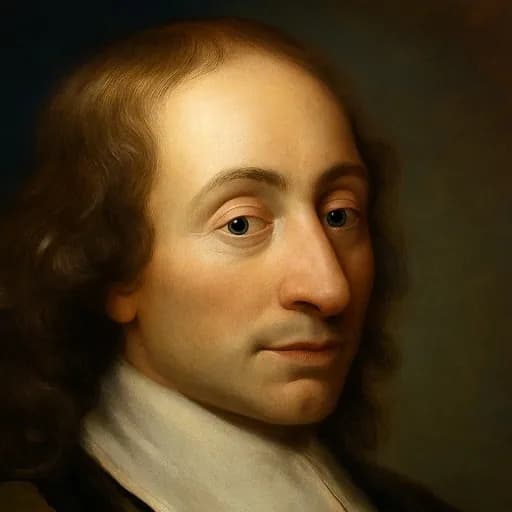
Blaise Pascal
Quotes
We do not content ourselves with the life we have in ourselves and in our own being; we desire to live an imaginary life in the mind of others, and for this purpose we endeavor to shine. We labor unceasingly to adorn and preserve this imaginary existence, and neglect the real. ...we would willingly be cowards in order to acquire the reputation of being brave. ...For he would be infamous who would not die to preserve his honor.
We do not rest satisfied with the present. We anticipate the future as too slow in coming, as if in order to hasten its course; or we recall the past, to stop its too rapid flight. So imprudent are we that we wander in the times which are not ours, and do not think of the only one which belongs to us; and so idle are we that we dream of those times which are no more, and thoughtlessly overlook that which alone exists. For the present is generally painful to us. We conceal it from our sight, because it troubles us; and if it be delightful to us, we regret to see it pass away. We try to sustain it by the future, and think of arranging matters which are not in our power, for a time which we have no certainty of reaching. Let each one examine his thoughts, and he will find them all occupied with the past and the future. We scarcely ever think of the present; and if we think of it, it is only to take light from it to arrange the future. The present is never our end. The past and the present are our means; the future alone is our end. So we never live, but we hope to live; and, as we are always preparing to be happy, it is inevitable we should never be so.
We are so presumptuous that we would wish to be known by all the world, even by people who shall come after, when we shall be no more; and we are so vain that the esteem of five or six neighbors delights and contents us.
We know then the existence and nature of the finite, because we also are finite and have extension. We know the existence of the infinite, and are ignorant of its nature, because it has extension like us, but not limits like us. But we know neither the existence nor the nature of God, because He has neither extension nor limits.
They say that eclipses foretoken misfortune, because misfortunes are common, so that, as evil happens so often, they often foretell it; whereas if they said that they predict good fortune, they would often be wrong. They attribute good fortune only to rare conjunctions of the heavens; so they seldom fail in prediction.
Bless yourself with holy water, have Masses said, and so on; by a simple and natural process this will make you believe, and will dull you — will quiet your proudly critical intellect.
...the only way to succeed in this life is to make ourselves appear honorable, faithful, judicious, and capable of useful service to a friend; because naturally men love only what may be useful to them. Now, what do we gain by hearing it said of a man that he has now thrown off the yoke, that he does not believe there is a God who watches our actions, that he considers himself the sole master of his conduct, and that he thinks he is accountable for it only to himself? Does he think that he has thus brought us to have henceforth complete confidence in him, and to look to him for consolation, advice, and help in every need of life? Do they profess to have delighted us by telling us that they hold our soul to be only a little wind and smoke, especially by telling us this in a haughty and self-satisfied tone of voice? Is this a thing to say gaily? Is it not, on the contrary, a thing to say sadly, as the saddest thing in the world?
This is what I see and what troubles me. I look on all sides, and I see only darkness everywhere. Nature presents to me nothing which is not matter of doubt and concern. If I saw nothing there which revealed a Divinity, I would come to a negative conclusion; if I saw everywhere the signs of a Creator, I would remain peacefully in faith. But, seeing too much to deny and too little to be sure, I am in a state to be pitied; wherefore I have a hundred times wished that if a God maintains nature, she should testify to Him unequivocally, and that, if the signs she gives are deceptive, she should suppress them altogether; that she should say everything or nothing, that I might see which cause I ought to follow. Whereas in my present state, ignorant of what I am or of what I ought to do, I know neither my condition nor my duty. My heart inclines wholly to know where is the true good, in order to follow it; nothing would be too dear to me for eternity.
To be happy man would have to make himself immortal; but, not being able to do so, it has occurred to him to prevent himself from thinking of death.
The sensibility of man to trifles, and his insensibility to great things, indicates a strange inversion.
Vanity is so anchored in the heart of man that a soldier, a soldier's servant, a cook, a porter brags, and wishes to have his admirers. Even philosophers wish for them. Those who write against it want to have the glory of having written well; and those who read it desire the glory of having read it. I who write this have perhaps this desire, and perhaps those who will read it …
Il n'est pas honteux pour l'homme de succomber sous la douleur et il est honteux de succomber sous le plaisir.

