


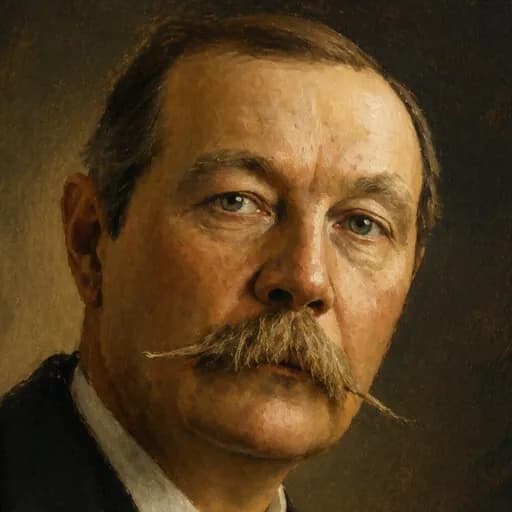
Arthur Conan Doyle
Quotes
I hardly looked at his face. His knees were what I wished to see.
Never trust to general impressions, my boy, but concentrate yourself upon details.
It is an old maxim of mine that when you have excluded the impossible, whatever remains, however improbable, must be the truth.
p. 315
It has long been an axiom of mine that the little things are infinitely the most important.
p. 194
"Do you know, Watson," said he, "that it is one of the curses of a mind with a turn like mine that I must look at everything with reference to my own special subject. You look at these scattered houses, and you are impressed by their beauty. I look at them, and the only thought which comes to me is a feeling of their isolation and of the impunity with which crime may be committed there."
p. 323
It is, of course, a trifle, but there is nothing so important as trifles.
p. 238
"Circumstantial evidence is a very tricky thing," answered Holmes thoughtfully. "It may seem to point very straight to one thing, but if you shift your own point of view a little, you may find it pointing in an equally uncompromising manner to something entirely different."
p. 204
My name is Sherlock Holmes. It is my business to know what other people don't know.
p. 254
"My dear Holmes," said I, "this is too much. You would certainly have been burned, had you lived a few centuries ago."
p. 162
"The stage lost a fine actor, even as science lost an acute reasoner, when he became a specialist in crime."
p. 170
To Sherlock Holmes she is always the woman. I have seldom heard him mention her under any other name. In his eyes she eclipses and predominates the whole of her sex. It was not that he felt any emotion akin to love for Irene Adler. All emotions, and that one particularly, were abhorrent to his cold, precise but admirably balanced mind. He was, I take it, the most perfect reasoning and observing machine that the world has seen, but as a lover he would have placed himself in a false position. He never spoke of the softer passions, save with a gibe and a sneer. They were admirable things for the observer — excellent for drawing the veil from men's motives and actions. But for the trained reasoner to admit such intrusions into his own delicate and finely adjusted temperament was to introduce a distracting factor which might throw a doubt upon all his mental results. Grit in a sensitive instrument, or a crack in one of his own high-power lenses, would not be more disturbing than a strong emotion in a nature such as his. And yet there was but one woman to him, and that woman was the late Irene Adler, of dubious and questionable memory.
p. 161
As Cuvier could correctly describe a whole animal by the contemplation of a single bone, so the observer who has thoroughly understood one link in a series of incidents should be able to accurately state all the other ones, both before and after.
p. 225

