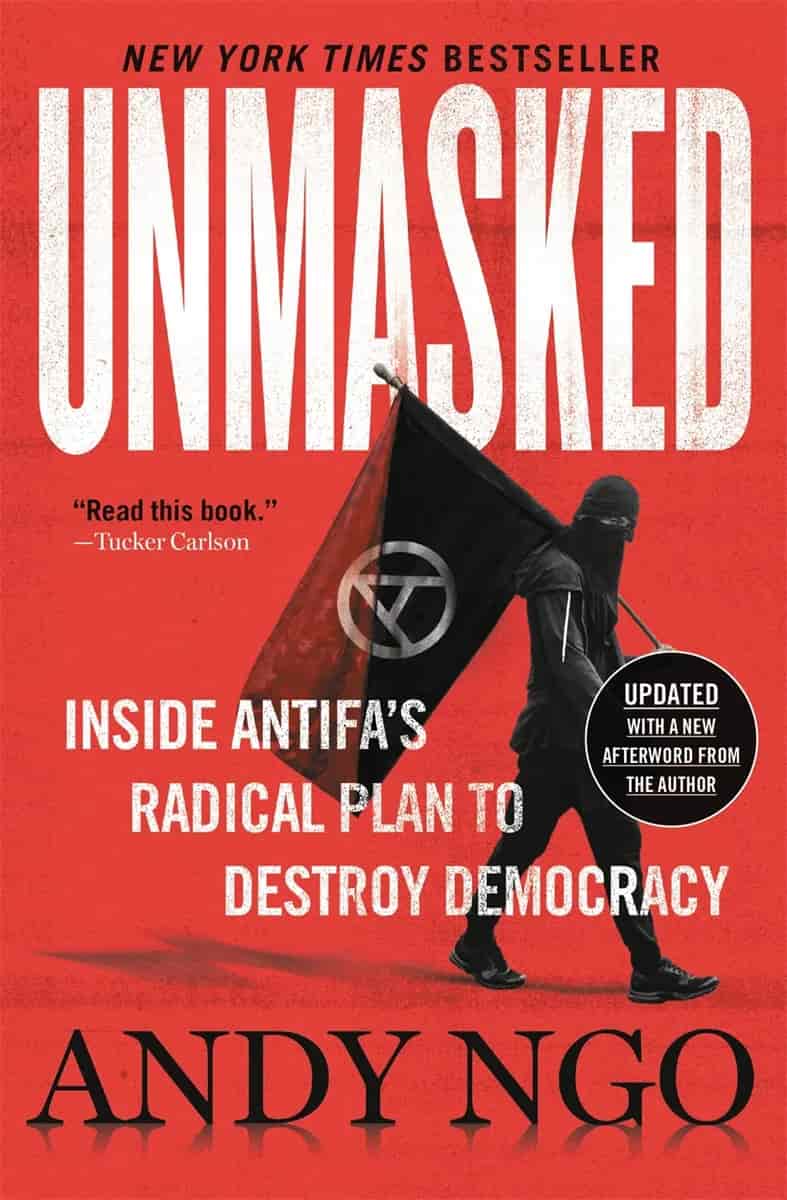
Andy Ngo
Quotes
Meanwhile, the daily violent antifa protests were becoming more organized and sophisticated. Media pundits inaccurately described what was happening as spontaneous and organic, but what I saw on antifa social media accounts was a deliberate, strategic, and organized plan to grow and entrench the riots. Through advertising on Reddit, Instagram, Snapshot, and Twitter, they were widely successful in getting support not just from antifa fans but also from the wider left.
p. 54
 Unmasked
What amazed me most about the strategic choice of weapons—both purchased and homemade—was how innocuous they looked on camera and to bystanders… [B[lack bloc rioters froze [water bottles] to make them hard as rocks. Taking one to the head could lead to a serious brain injury or death. And intermixed with the plastic bottles were glass bottles and canned food. Other popular weapons were slingshots. Rioters stood hundreds of feet back and fired off marbles and metal ball bearings. On camera, they looked deceptively like children’s toys. And the umbrellas rioters used to shield themselves from cameras. On at least one confirmed occasion and likely more, rioters attached blades to the tips of the umbrellas so they could double as weapons.
p. 58
UnmaskedSince 2015, untold numbers of victims, including other journalists, have been doxed, beaten, robbed, or killed by antifa militants. Few of them receive media attention—or justice.
p. 4
UnmaskedFaizel Khan, the owner of Café Argento, told the New York Times: ‘They barricaded us all in here.’ He didn’t dare speak out to media until weeks after CHAZ’s demise. ‘[T]hey were sitting in lawn chairs with guns.’ His testimony to the paper comports with what I witnessed myself. Though there thousands in CHAZ during the day, actual business was incredibly slow. Customer traffic was severely impacted from the street blockades. People could only travel in and out by foot.
p. 38
UnmaskedAll that occurred on just the first night of rioting in Portland. It continued the next day, and the day after that, and the day after that. For weeks, rioters descended on the Justice Center every night as if it were a ritual. They’d surround the building, confront the police standing guard, and attack them with projectiles and mortar explosives. Many of them used powerful lasers against the police that could burn eyes and cause permanent damage to vision. By the middle of the summer, these lasers became so numerous that the rioters who carried them organized into their own ‘unit, and the protests began to look like laser shows.
p. 53
UnmaskedOne of the most effective ways we’ve seen law enforcement agencies brought to their knees is through frivolous lawsuits bankrolled by endless donors. ‘Lawfare’ refers to the act of abusing the legal system to achieve goals.
p. 59
Unmasked[I[n 2020 numerous mainstream left-wing commentators began criticizing the very notion of property rights. ‘Destroying property, which can be replaced, is not violence,’ said New York Timesreporter Nikole Hannah-Jones in a CBS News interview in June of 2020.
p. 17
UnmaskedThe Portland General Defense Committee publishes a financial accountability page on its website… Bail bonds ranging from several hundred dollars up to $50,000 were paid for more than a hundred people. In effect, the group is using a GoFundMe campaign to channel money to causes that are otherwise not allowed on the platform.
p. 57
Unmasked[T]he Youth Liberation Front (YLF), the antifa group in Portland that took the lead in organizing riots, used ‘cyberswarming’ to coordinate real-world direct action. Cyberswarming is the act of calling online followers to a real-life location or event. Antifa traditionally use it to immediately mobilize a crowd against people they perceive to be ideological threats. But in 2020, they were using it to direct people to locations to riot.
p. 54
UnmaskedIn mid-July, the federal government put up a strong reinforced barrier around the courthouse. Other barriers previously put up were quickly torn apart. This one was made of thick steel, and it was reinforced by concrete blocks on the other side. The fence withstood for many days, but on the fifty-ninth night of rioting, hundreds gathered with tools and equipment to bring down the barrier. They used electric saws to cut into the fence, but the holes they made were too small for people to fit through. Next, they tied rope around strategic points of the fence, and hundreds of rioters participated in pulling it down.
p. 66
UnmaskedWhile CHAZ was ostensibly created to be an explicitly ‘anti-racist’ zone, it ended up segregating along racial lines. Most of CHAZ’s black residents and black visitors did not follow antifa’s anarchist-communist ideology. Some actively took issue with antifa’s destruction and vandalism of the space. The white anarchist, socialist, and communist radicals mostly stayed together in their spaces.
p. 36
UnmaskedThere exist large networks of far-left attorneys and legal groups who bring endless lawsuits in an attempt to defund, cripple, and embarrass police. In early June 2020, far-left BLM-style group Don’t Shoot Portland filed a class action lawsuit against the city to stop the use of tear gas.
p. 59
Unmasked