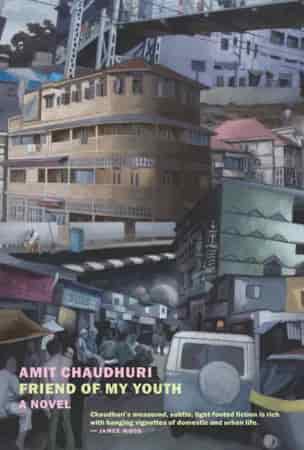
Amit Chaudhuri
Quotes
Fantasists aren't natural readers. They grow restive easily.
I love churches in Bombay...they make me think of shadow. Of footfall on stone. In England, churches preside over their habitat till they're gratuitous.
Mahadev Govind Ranade. Leaving aside his air of self-importance, he looks marginally foreign, as all statues do.
Only drunks stare at statues .... I never liked the statues keeping vigil, primarily because they were too close to life.
Class was what formed you, but didn’t travel to other cultures – it became invisible abroad. In foreign places, you were singled out by religion and race, but not class, which was more indecipherable than any other mother tongue. He’d learnt that not only were light, language, and weather contingent – class was too.
Frame after aluminium frame had replaced the casements. The gesture by which you push a window open was now unnecessary. ... It was as if a part of us that was air and breeze had been denied entry.
Each view has a history. You sense you're where others have been.
'I think of Ramu. The Ramu I know and the Ramu I'm writing about have become indistinguishable. The same's true of the Bombay I'm recounting from experience and the Bombay I'm assembling through words. This is often how novels begin for me. There's a convergence. I live. Then something prompts me to write. The writing is not about life. It is a form of living. The two happen simultaneously.
This is what's beautiful about staying in a club or hotel: you're invisible, as is your neighbour.
History is always lying before you, unnoticed: till you suddenly see it, as we do now.
... "shagging" - a quasi-comical activity, like belching or farting, except it was more taboo and more necessary than these.
There must be other leaps in life - as momentous as the "mirror stage" - that Lacan didn't mention. Some are universal; others, culturally particular. To understand that your parents are human (and not an element of the natural world), that they're separate from you, that they were children once, that they were born and came into the world, is another leap. It's as if you hadn't seen who they were earlier - just as, before you were ten months old, you didn't know it was you in the mirror. This happens when you're sixteen or seventeen. Not long after - maybe a year - you find out your parents will die. It's not as if you haven't encountered death already. But, before now, your precocious mind can't accommodate your parents' death except as an academic nicety - to be dismissed gently as too literary and sentimental. After that day, your parents' dying suddenly becomes simple. It grows clear that you're alone and always have been, though certain convergences start to look miraculous - for instance, between your father, mother, and yourself. Though your parents don't die immediately - what you've had is a realisation, not a premonition - you'll carry around this knowledge for their remaining decades or years. You won't think, looking at them, "You're going to die". It'll be an unspoken fact of existence. Nothing about them will surprise you anymore.