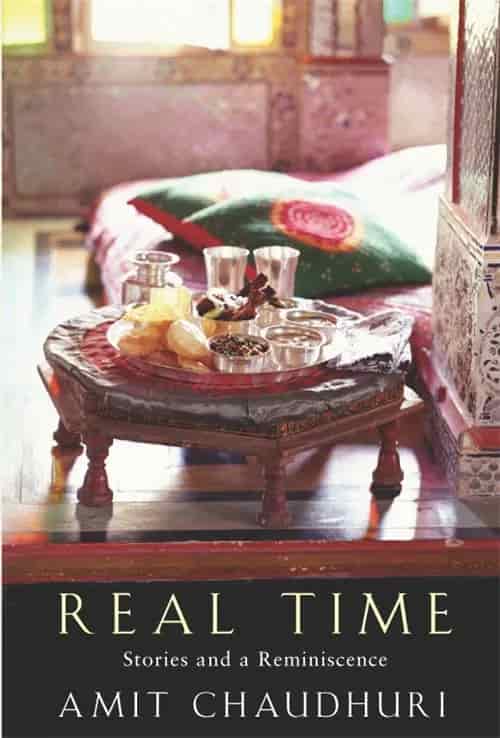
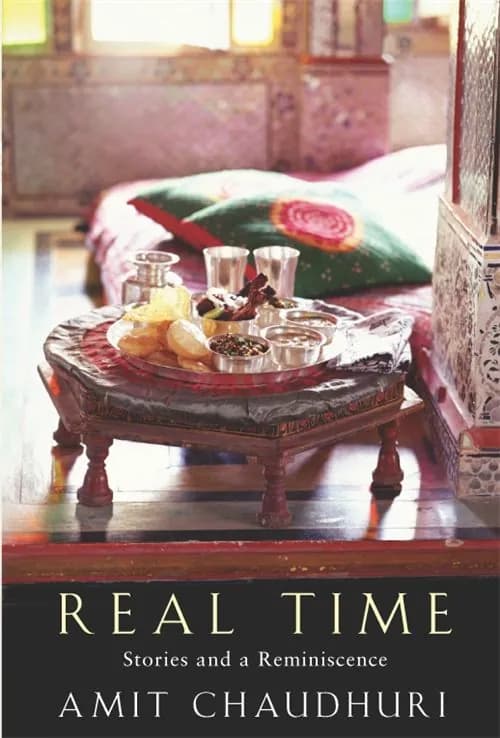
Amit Chaudhuri
Quotes
Water begins to boil in the kettle; it starts as a private, secluded sound, pure as rain, and grows to a steady, solipsistic bubbling.
Abhi, Babla and Sandeep slept like primeval creatures huddled on the island of the bed, close to the horizon, outwaiting the dawn that would bring the first thought to their heads. Their bodies slept with a pure detached love for every moment of sleep.
... my mother will settle on the rug and unclip the bellows, pulling and pushing them with a mild aquatic motion with her left hand, the fingers of the right hand flowering upon the keys, the wedding-bangle suspended around her wrist. Each time the bellows are pushed, the round holes on the back open and close like eyes. Without the body music is not possible; it provides the hollow space for resonance as does the curved wooden box of the violin or the round urn of the sitar. At the moment of singing, breath tips in the swelling diaphragm as water does in a pitcher. The voice-box itself is a microscopic harp, its cords tautening and relaxing with each inflection.
Trenches and mounds of dust everywhere give the city a strange bombed-out look.
When afternoon came to Vidyasagar Road, wet clothes ... hung from a clothesline which stretched from one side to another on the veranda of the first floor. The line, which had not been tightly drawn anyway, sagged with the pressure of the heavy wet clothes that dripped, from sleeves and trouser-ends, a curious grey water on to the floor, and, especially in the middle, one noticed the line curved downwards, as if a smile were forming.
Tinkling sounds came from outside, of hammering and chiselling, as labourers worked like bees, and seven- or eight-storeyed buildings rose in the place of ancestral mansions that had been razed cruelly to the ground, climbing up like ladders through screens of dust. An old mansion opposite the veranda had been repainted white, to its last banister and pillar, so that it looked like a set of new teeth. ... In another sphere altogether, birds took off from a tree or parapet, or the roof of some rich Marwari’s house, startling and speckling the neutral sky. Not a moment was still or like another moment. In a window in a servants’ outhouse attached to a mansion – both the master’s house and the servants’ lost in a bond now anachronistic and buried – a light shone even at this time of the day, beacon of winter.
The city was still .... Soon the machinery would start working again, not out of any sense of purpose, but like a watch that is wound daily by someone’s hand. Almost without any choice in the matter, people would embark upon the minute frustrations and satisfactions of their daily lives. It was in this moment of postponement that the azaan was heard, neither announcing the day nor keeping it a secret.
‘This second time round, she’d discovered that to be happy was not so much a self-sufficient, spontaneous emotion, such as you might feel in relation to a dream or a secret, but a way of reacting to the rest of the world; that to be happy this time, she must curb the natural human instinct to look up at the sky, with its all-encompassing definition, and gaze towards the immediate ground and horizon, with its lack of shape, or abode, or clear ending.’
‘I’m uncomfortable beginning at the beginning. It’s not because I’m clever, but because it’s a difficult thing, writing.’
‘... the menu’s a delirious poem/on which the names of Moghlai and Punjabi and Parsi/
... the cleverest way of battling the heat was not moving.
There was a special purpose in these throws, for the readers of Ganashakti were fellow-travellers of the Communist party, they believed in its necessity and vision, and an inexplicable bond was formed between the distributor, whose every aim with the bundle seemed to be a salute, and the silent house.