Aldous Huxley
Quotes
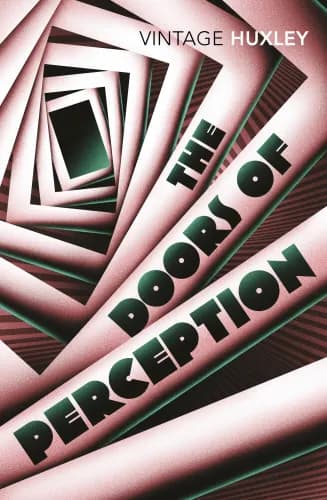
These effects of mescalin are the sort of effects you could expect to follow the administration of a drug having the power to impair the efficiency of the cerebral reducing valve. When the brain runs out of sugar, the undernourished ego grows weak, can't be bothered to undertake the necessary chores, and loses all interest in those spatial and temporal relationships which mean so much to an organism bent on getting on in the world. As Mind at Large seeps past the no longer watertight valve, all kinds of biologically useless things start to happen. ... Other persons discover a world of visionary beauty. To others again is revealed the glory, the infinite value and meaningfulness of naked existence, of the given, unconceptualized event.
p. 26
We live together, we act on, and react to, one another; but always and in all circumstances we are by ourselves. The martyrs go hand in hand into the arena; they are crucified alone. Embraced, the lovers desperately try to fuse their insulated ecstasies into a single self-transcendence; in vain. By its very nature every embodied spirit is doomed to suffer and enjoy in solitude. Sensations, feelings, insights, fancies — all these are private and, except through symbols and at second hand, incommunicable. We can pool information about experiences, but never the experiences themselves. From family to nation, every human group is a society of island universes.
To be shaken out of the ruts of ordinary perception, to be shown for a few timeless hours the outer and inner world, not as they appear to an animal obsessed with survival or to a human being obsessed with words and notions, but as they are apprehended, directly and unconditionally, by Mind at Large — this is an experience of inestimable value to everyone and especially to the intellectual.
And suddenly I had an inkling of what it must feel like to be mad.
"So you don't much like civilization, Mr. Savage,"
Well, duty's duty. One can't consult one's own preference. I'm interested in truth, I like science. But truth's a menace, science is a public danger. As dangerous as it's been beneficent. It has given us the stablest equilibrium in history. China's was hopelessly insecure by comparison; even the primitive matriarchies weren't steadier than we are. Thanks, I repeat, to science. But we can't allow science to undo its own good work. That's why we so carefully limit the scope of its researches–that's why I almost got sent to an island. We don't allow it to deal with any but the most immediate problems of the moment. All other enquiries are most sedulously discouraged.
"One would think he was going to have his throat cut," said the Controller, as the door closed. "Whereas, if he had the smallest sense, he'd understand that his punishment is really a reward. He's being sent to an island. That's to say, he's being sent to a place where he'll meet the most interesting set of men and women to be found anywhere in the world. All the people who, for one reason or another, have got too self-consciously individual to fit into community-life. All the people who aren't satisfied with orthodoxy, who've got independent ideas of their own. Every one, in a word, who's any one. I almost envy you, Mr. Watson."
"O brave new world," he repeated. "O brave new world that has such people in it. Let's start at once."
"You remind me of another of those old fellows called Bradley. He defined philosophy as the finding of bad reason for what one believes by instinct..."
And those childish rhymes how magically strange and mysterious!
"We are not our own any more than what we possess is our own. We did not make ourselves, we cannot be supreme over ourselves. We are not our own masters. We are God's property. Is it not our happiness thus to view the matter? Is it any happiness or any comfort, to consider that we are our own? It may be thought so by the young and prosperous. These may think it a great thing to have everything, as they suppose, their own way–to depend on no one–to have to think of nothing out of sight, to be without the irksomeness of continual acknowledgment, continual prayer, continual reference of what they do to the will of another. But as time goes on, they, as all men, will find that independence was not made for man–that it is an unnatural state–will do for a while, but will not carry us on safely to the end."
Oh, God, God, God..." the Savage kept repeating to himself. In the chaos of grief and remorse that filled his mind it was the one articulate word. "God!" he whispered it aloud. "God..."