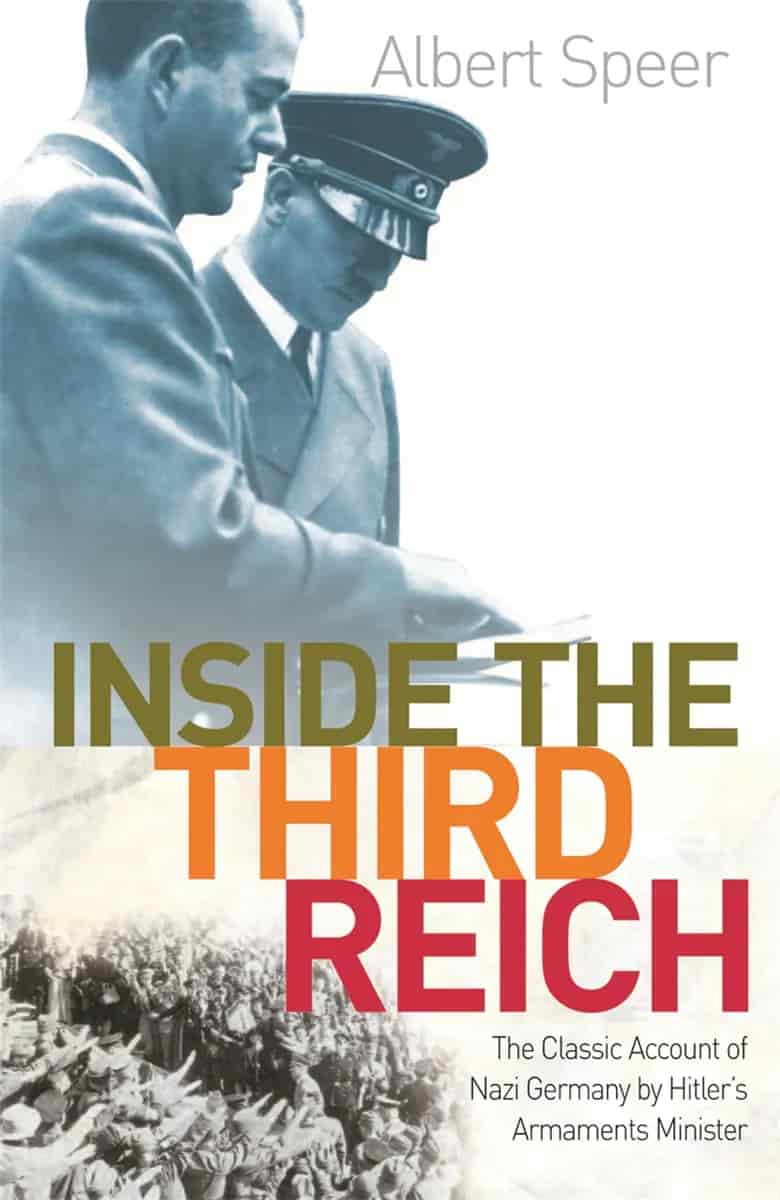
At this time a high-ranking SS leader hinted to me that Himmler was preparing decisive steps. In February… — Albert Speer
At this time a high-ranking SS leader hinted to me that Himmler was preparing decisive steps. In February 1945, the Reichsführer-SS had assumed command of the Vistula Army Group, but he was no better than his successor at stopping the Russian advance. Hitler was now berating him also. Thus what personal prestige Himmler had retained was used up by a few weeks of commanding frontline troops. Nevertheless, everyone still feared Himmler, and I felt distinctly shaky one day on learning that Himmler was coming to see me about something that evening. This, incidentally, was the only time he ever called on me. My nervousness grew when Theodor Hupfauer, the new chief of our Central Office- with whom I had several times spoken rather candidly- told me in some trepidation that Gestapo chief Kaltenbrunner would be calling on him at the same hour. Before Himmler entered, by adjutant whispered to me: "He's alone." My office was without window panes; we no longer bothered replacing them since they were blasted out by bombs every few days. A wretched candle stood at the center of the table; the electricity was out again. Wrapped in our coats, we sat facing one another. Himmler talked about minor matters, asked about pointless details, and finally made the witless observation: "When the course is downhill there's always a floor to the valley, and once it is reached, Herr Speer, the ascent begins again." Since I expressed neither agreement nor disagreement with this proverbial wisdom and remained virtually monosyllabic throughout the conversation, he soon took his leave. I never found out what he wanted of it, or why Kaltenbrunner called on Hupfauer at the same time. Perhaps t hey had heard about my critical attitude and were seeking allies; perhaps they merely wanted to sound us out.
p. 427Source: Wikiquote · CC BY-SA 4.0

More from this book
Around the middle of February, I called on Goering one evening in Karinhall. I had discovered from studying the military map that he had concentrated his parachute division around his hunting estate. For a long time he had been made the scapegoat for all the failures of the Luftwaffe. At the situation conferences Hitler habitually denounced him in the most violent and insulting language before the assembled officers. He must have been even nastier in the scenes he had with Goering privately. Often, waiting in the anteroom, I could hear Hitler shouting at him. That evening in Karinhall, I established a certain intimacy with Goering for the first and only time. Goering had an excellent Rotschild-Lafite served at the fireplace and ordered the servant not to disturb us. Candidly, I described my disappointment with Hitler. Just as candidly, Goering replied that he well understood me and that he often felt much the same. However, he said, it was easier for me, since I had joined Hitler a great deal later and could free myself from him all the sooner. He, Goering, had much closer ties with Hitler; many years of common experiences and struggles had bound them together- and he could no longer break loose.
p. 426
Actually, a kind of state socialism seemed to be gaining more and more ground, furthered by many of the [Nazi] party functionaries. They had already managed to have all plants owned by the state distributed among the various party districts and subordinated to their own district enterprises... Our very system of industrial direction in the interests of war production could easily become the framework for a state-socialist economic order. The result was that our organization, the more efficient it became, was itself providing the party leaders with the instruments for the doom of private enterprise.
p. 359
In contrast to the ultimate realization that he was dealing with a formidable enemy in the east, Hitler clung to the end to his preconceived opinion that the troops of the Western countries were poor fighting material. Even the Allied successes in Africa and Italy could not shake his belief that these soldiers would run away at the first serious onslaught. He was convinced that these soldiers would run away from the first serious onslaught. He was convinced that democracy enfeebled a nation. As late as the summer of 1944 he held to his theory that all the ground that had been lost in the West would be quickly reconquered. His opinions on the Western statesmen had a similar bias. He considered Churchill, as he often stated during the situation conferences, an incompetent, alcoholic demagogue. And he asserted in all seriousness that Roosevelt was not a victim of infantile paralysis but of syphilitic paralysis and was therefore mentally unsound. These opinions, too, were indications, of his flight from reality in the last years of his life.
p. 306