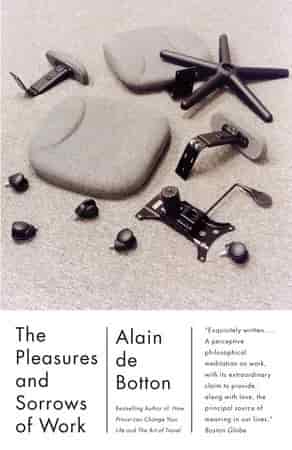
Death is hard to keep in mind when there is work to be done. … Work does not by its nature permit us to do… — Alain de Botton
Death is hard to keep in mind when there is work to be done. … Work does not by its nature permit us to do anything other than take it too seriously. It must destroy our sense of perspective, and we should be grateful to it for precisely this reason, for allowing us to mingle ourselves promiscuously with events, for letting us wear thoughts of our own death and the destruction of our enterprises with beautiful lightness, as mere intellectual propositions. … We function of the basis of a necessary myopia. Therein is the sheer energy of existence, a blind will no less impressive than that which we find in a moth arduously crossing a window ledge, … refusing to contemplate the broader scheme in which he will be dead by nightfall. The arguments for our triviality and vulnerability are too obvious, too well known and tedious to rehearse. What is interesting is that we may take it upon ourselves to approach tasks with utter determination and gravity even when their wider non-sense is clear. The impulse to exaggerate the significance of what we are doing, far from being an intellectual error, is really life itself coursing through us.
p. 324Source: Wikiquote · CC BY-SA 4.0
More from this book
To look at the paper is to raise a seashell to one’s ear and to be overwhelmed by the roar of humanity.
p. 237
Symons … remarked that the most common and unhelpful illusion plaguing those who came to see him was the idea that they ought somehow, in the normal course of events, to have intuited—long before they had finished their degrees, started families, bought houses and risen to the top of law firms—what they should properly be doing with their lives. They were tormented by a residual notion of having through some error or stupidity on their part missed out on their true calling.
p. 113
The pre-scientific age, whatever its deficiencies, had at least offered its members the peace of mind that follows from knowing all man-made achievements to be nothing next to the grandeur of the universe. We, more blessed in our gadgetry but less humble in our outlook, have been left … having no more compelling repository of veneration than our brilliant, precise, blinkered and morally troubling fellow human beings.
p. 168